

Formula 1 was the dream and Cranfield was the conduit
10/09/2026

I still remember the exact moment Formula 1 (F1) got its hooks into me. I was in my first year of an aerospace undergraduate engineering degree when I watched a video about the sport – I had known about F1 growing up and watching it in the early 2010s, but something just clicked. It was instant. I remember thinking, “That looks so cool. I want to work in Formula 1.” From that day, everything I did was, in one way or another, chasing that goal.
Before Paris I’d started out studying physics at university back home in France. I loved the subject, but I found it too theoretical, and I wanted something more applied something I could build and test, not just calculate. That’s what took me to the Institut polytechnique des sciences avancées (IPSA) in Paris to study aerospace engineering, and it’s where the Formula One video found me at exactly the right time.
Why Automotive Mechatronics?
Once I knew I wanted to work in motorsport, the question became how. I did my research and saw that Cranfield had an outstanding reputation in the industry, with a long list of alumni working across Formula 1, so when I discovered I could do a double degree between IPSA and Cranfield in my final year, it was an easy decision. In fact, Cranfield was the only UK university on my school’s partner list. So, in some ways the choice was made for me. But even if I’d had a dozen options, I don’t think I’d have chosen differently.
I joined the Automotive Mechatronics MSc in 2022, drawn by the fact that Cranfield’s course sits right at the intersection of mechanical, electrical and software engineering – exactly the blend that modern motorsport and automotive careers demand. I graduated in 2023, and was fortunate enough to secure a place on the graduate scheme at Red Bull Powertrains during my final year. I handed in my thesis the day before I started my new job.
I won’t pretend the move was easy at first. I’d spent the previous few years living in the middle of Paris, and Cranfield is about as different from that as you can get. But where I grew up in France was a tiny village of around 50 people, so in a strange way, being at Cranfield felt like coming home. What I found there was a genuinely close community because you’re a little removed from a big city, you end up studying together, helping each other through assignments, and building real friendships. Looking back, I think that closeness was one of the best parts of the whole experience.
Channeling my curiosity
If I’m honest, my relationship with control systems didn’t start well. I had a module on it early in my engineering undergraduate degree and genuinely did not connect to it. But once I properly focused on it, something shifted, and by the time I reached Cranfield, I couldn’t get enough of it. Every module seemed to open another door: you’d learn something and think, I didn’t know you could do this – and then the next module would go even further. It made me realise there is a huge amount you can do with control systems, spanning the entire life of a product from first principles to a finished, working system.
Two modules stand out to me looking back. Mechatronics Modelling for Vehicle Systems finally showed me where the transfer functions I’d been using for years came from – taking real physics phenomena and building them up into the equations engineers use every day. It was one of those moments where everything just clicked into place. And in Vehicle Dynamics – Modelling, Simulation and Performance, we’d study the theory one week and then get out on the track with a real car the next, seeing the exact behaviour we’d calculated on paper play out in front of us. That’s the thing I valued most about Cranfield: it never let the theory stay abstract for long.
The practical, hands-on nature of the course is something I’d encourage anyone considering it to look forward to. I wasn’t a huge fan of my undergraduate degree because it felt too theoretical, so getting to see ideas become physical, moving, measurable things at Cranfield reignited my enthusiasm completely. There’s something genuinely motivating about watching a phenomenon you’ve studied on paper actually happen in real life. It’s what kept driving me to learn more.
What really set Cranfield apart for me, though, was how accessible the academics were. I’ve always been someone who gets curious about a topic and wants to go and pick a professor’s brain about it, and at Cranfield that was always encouraged. I never once felt like a lecturer was unsure of what they were teaching. If they didn’t know the answer to something, they’d know exactly who did and would point me in the right direction. That kind of confidence and generosity from the teaching team makes you want to dig deeper into everything.
What Cranfield really taught me
Beyond the technical knowledge, two things from my time at Cranfield have stayed with me every single day at work. The first is time management. Cranfield’s teaching structure , one intensive week on a subject, followed by an assignment week forced me to plan properly: deciding what I needed to do, and on which day, to hit a deadline. That’s almost exactly how I manage large projects at work now, breaking them down and spreading the effort evenly rather than leaving everything to the end.
The second is attention to detail. There’s an expression that ‘the devil hides in the details’. In Formula 1, those tiny, marginal details are often the difference between finishing first and second. At Cranfield, it would have been easy to just be a smaller part of a team on a group design project or thesis and get away with it. But I always wanted to go further, because ultimately it was for my own benefit, and that habit has carried straight through into how I approach my work today.
I’d also say the multicultural side of the course was a huge, and unexpected, positive. My class had people from France, Taiwan, India, the US and elsewhere, and rather than being a challenge, it turned into one of the richest parts of the experience – sharing festivities, learning from each other’s cultures, and building friendships that have lasted well beyond graduation. Coming from Paris, I wondered at first how a smaller, more rural university would compare, but that closeness is exactly what made those relationships possible.
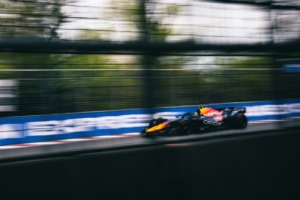
Red Bull Powertrains Limited (RBPT) is a Formula One power unit manufacturer owned by Red Bull GmbH and based in Milton Keynes. Red Bull Racing are one of the most successful Formula 1 teams of the past 20 years.
Life after Cranfield
Today I work as a Calibration Methodology Engineer at Red Bull Powertrains, having joined through their graduate scheme straight after Cranfield as a Control Systems Engineer. The transition from my Automotive Mechatronics course into the role was smoother than I expected. A lot of what I now do day-to-day, I’d either studied directly or discussed in lectures, so the concepts felt familiar even though the environment, moving from academia into a professional Formula One workplace took some adjustment.
Being a genuine fan of the sport before I ever set foot in the factory has, if anything, made the job more rewarding. When you care about something deeply, you naturally want to go that extra mile, and I think that pushes the whole team’s competitiveness up. Where I used to just watch the races as an outsider, now if I see us struggle on a Sunday, I get to go into the factory on Monday and be part of the conversation about how we improve it. That sense of having a genuine part to play is something I don’t take for granted.
This is our first year manufacturing a power unit entirely from scratch, and while we know there’s more work to do, we’re proud of how it’s performing. Ultimately, the motivation is simple: we want to win races, and we want to win the Constructors’ Championship. Being second isn’t a reason to stop pushing, and I think that drive is what unites almost everyone at Red Bull Powertrains.
My advice? Be proactive!
If you’re starting out at Cranfield, or thinking about applying with a dream a bit like mine, my honest advice is this: don’t just go to class and go home again. Get involved in something outside your course — a society, a sports club, Formula Student, a volunteering project, anything that shows you’re genuinely committed and curious, not just chasing grades. A lot of applicants for graduate roles have very similar degrees from very similar schools, so what sets you apart is what you’ve done beyond the syllabus.
Make the most of how accessible the academics are — go and ask questions after class, get involved with the Careers and Employability Service, and don’t be afraid to pursue a curiosity that isn’t strictly on the syllabus. And embrace the community around you. Cranfield’s life on campus is smaller and quieter than a big city, but that’s exactly what makes it special: you’ll study together, celebrate together, and build friendships with people from all over the world that will stay with you long after you graduate. Looking back, that combination — the practical, industry-linked teaching, the closeness of the community, and the sheer number of people who go out of their way to help you succeed — is what turned my Formula One dream into a career. I’d genuinely recommend it to anyone chasing something similar.
Interested in a career at the intersection of mechanical, electrical and software engineering? Find out more about the Automotive Mechatronics MSc at Cranfield University.


Categories & Tags:
Leave a comment on this post:
You might also like…
Formula 1 was the dream and Cranfield was the conduit
I still remember the exact moment Formula 1 (F1) got its hooks into me. I was in my first year of an aerospace undergraduate engineering degree when I watched a video about the sport ...
Introducing Barrington Library
Welcome to all our new students! Barrington Library supports all the students and staff at Cranfield Defence and Security on the Shrivenham site. We are looking forward to meeting you all soon, in person or ...

About to start your journey at Cranfield? We’re here to help!
Congratulations on accepting your offer to study at Cranfield! If you’re keen to get a head start before your course begins, our Library Services team is here to support you every step of the way. ...
Bank holiday hours for Library Services: Monday 31 August
Library Services staff will be taking a break on Monday 31 August for the bank holiday. You will still be able to access all the resources and help you need via our library website. The 24/7 ...

The real cost of studying in the UK – what international students need to budget for
Moving overseas to pursue a postgraduate degree is one of the most exciting investments you can make in your future. It's also one of the most significant financial commitments you and your family will ...
Seven things you should definitely prepare for before studying at Cranfield University
You're thinking about Cranfield. Maybe you've done the virtual tour, read through the course pages, spoken to the course director or attended a webinar. Now, you're trying to figure out what life here is ...