

Boosting flight safety: Cranfield’s icing wind tunnel in action
10/08/2026

The icing wind tunnel (IWT) was established at Cranfield University in 2003. The facility is capable of producing impact ice on models mounted within a range of different test sections.
At present, the Cranfield IWT (figure 1) is the largest in the UK. The IWT can produce realistic icing conditions that are encountered in aviation, which is of interest to researchers in the field of icing science and organisations engaged in the development of ice detection and mitigation systems.

Figure 1: Cranfield icing wind tunnel (IWT) facility.
Understanding ice formation: why is icing an issue for aircraft?
One of the fundamental aspects of icing science is the behaviour of ice as a material and the interface with the substrate. It is challenging to predict ice accretion, strength of surface adhesion and the behaviour in response to applied thermo-mechanical loads.
A considerable amount of research, both experimental and computational, has been conducted in the past few decades to understand the secrets behind ice formation. Water droplets in clouds can cool well below freezing point and yet remain liquid. It is often only when the droplets touch a solid object that they freeze. Aircraft, tall buildings, wind turbines and even crops can be greatly affected by the ice which forms on them due to windborne droplets. This type of ice is called impact ice, which is characterised by supercooled water droplets.
On aircraft, the presence of ice on aerodynamic surfaces can lead to loss of lift, affect the controllability of the aircraft and in worst cases lead to a stall. This is a serious hazard and requires mitigation. Ice protection systems (IPS) usually form a necessary part of every certified aircraft. These systems allow the aircraft to become capable of flight into known icing (FIKI).
The Cranfield IWT is capable of reproducing these atmospheric icing conditions encountered in flight. This is of interest to aerospace organisations engaged in icing research such as Airbus, Rolls-Royce, Safran, TEI, Parker-Meggitt and Spirit Aerosystems.
A medium for icing research
Over the years, the Cranfield IWT has undertaken several high complexity research projects. Some of these were major research projects funded by the European Union or Innovate UK. Alternatively, industrial partners also hire the Cranfield IWT facility to perform icing test campaigns through commercial contracts.
The facility consists of a closed loop, horizontal icing tunnel capable of working section flow speeds of 100m/s and a minimum temperature of -30 °C. The maximum liquid water content which can be delivered by the tunnel spray system is 5g/m3. The vertical droplet facility, which forms a part of the IWT, can produce a stream of mono-dispersed droplets, which are used to study droplet impact and freezing dynamics using flow visualisation techniques like high speed shadowgraphy.
The projects undertaken in the facility can range from testing of new ice protection equipment, validating design tools for simulating ice growth, examining the potential role of ice phobic surface coatings and demonstration of novel ice protection concepts.
Case studies: ICE GENESIS (EU Horizon 2020) – engine cascade rig (work package 8)
The aim of this project was to understand and measure ice accretion under various test matrix conditions within a cascade rig, which replicated a stage of stator vanes, strut and internal
guide vanes (IGV) from an aircraft gas turbine engine. A secondary objective of this project was to assess the performance of a new electrothermal ice protection system for the IGVs.
The project consisted of the design, construction, integration and calibration of a new test configuration, which replaced the standard test section of the IWT. This configuration split the
incoming air from the convergent section of the tunnel into two flow sections. The flow was divided into a bypass section and a core flow section.
The ice formation under various icing conditions was observed with high-definition video cameras and thermal imaging cameras. Each blade within the cascade rig was instrumented to obtain its temperature under icing conditions. The characteristics were measured with the ice protection systems activated or switched off.
Post test, the shape of the ice accreted on the blades was determined using a 3D scanning system which was setup in the freezer room adjoining the IWT. This was made possible due to a cassette-release system, which allowed the rapid disassembly of the stator blade row from the cascade without affecting the ice formed on the blades.
Safran Aero Engines and the Austrian Institute of Icing Science (AIIS) were the major collaborators on this project. Figure 2 shows the ice accreted in the IGV blades (left) and the 3D scanned image of ice accreted on a stator vane (right). Figure 3 shows the 3D CAD model of the primary flow section of the cascade rig integrated with the IWT. The bypass section is omitted for clarity.
 Figure 2: ICE GENESIS cascade rig core flow section and 3D scanned blade.
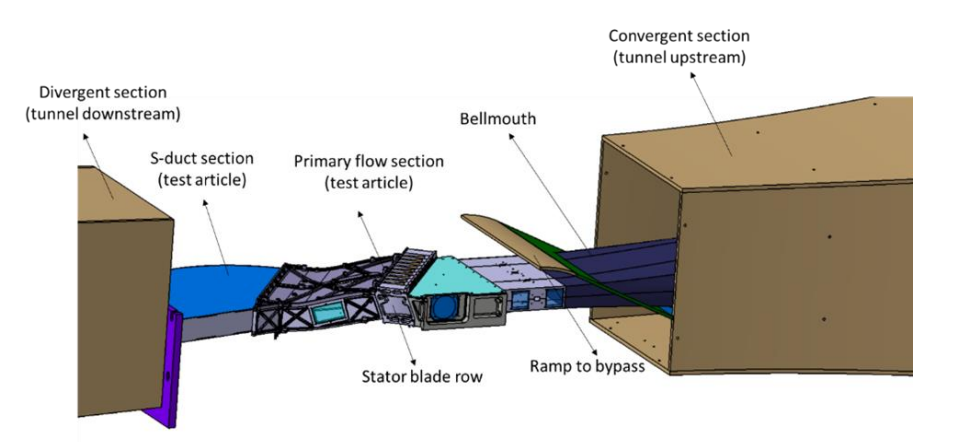
Figure 3: ICE GENESIS cascade rig integrated with Cranfield IWT (primary flow section only).
At forefront of icing science and engineering
The Cranfield IWT holds a unique place within the atmospheric icing research community due to its participation in major research projects on icing and a demonstrated track record of performing world-class research on icing topics. The tunnel continues to operate and provide a unique and valuable service to the community through research on both fundamental icing
science as well as more applied aspects such as novel ice protection and detection systems.
Find out more here


Categories & Tags:
Leave a comment on this post:
You might also like…
Introducing Kings Norton Library
Welcome to all our new students! We are looking forward to meeting you soon. You will find Kings Norton Library in the centre of the Cranfield campus, and it is open 24/7 to all staff ...

Setting your research on the right course: Four questions every researcher should ask
Whether you are just beginning your doctoral journey or are already well into your research career, successful research rarely happens by accident. Like any successful mission, it depends on good planning, informed decisions, and getting ...

5 budgeting mistakes students make (and how to avoid them)
Good financial planning isn't about how much money you have. It's about the habits you build. We asked Dr Lakshmy Subramanian, Course Director for the Banking, Economics and Finance MSc, about the budgeting mistakes ...
Finding your reading materials
Use Library Search Library Search is the first place to start when you are trying to find academic sources for your work. This is the search box on the library website homepage. It allows you ...
Formula 1 was the dream and Cranfield was the conduit
I still remember the exact moment Formula 1 (F1) got its hooks into me. I was in my first year of an aerospace undergraduate engineering degree when I watched a video about the sport ...
Introducing Barrington Library
Welcome to all our new students! Barrington Library supports all the students and staff at Cranfield Defence and Security on the Shrivenham site. We are looking forward to meeting you all soon, in person or ...