


How do I reference… a conference paper in the APA7 style?
29/08/2023

Many of you will be using conference papers in your work. Some of these will also have been published as articles in the traditional way – but others are not. So, how do you go about referencing a conference paper in your work?
First of all, you need to collect together the following ‘elements’ to build your reference:
- Author or authors – in the format Surname, Initials.
- Date(s) of conference in full – in the format (Year, Month Day(s)).
- Title of conference paper [followed by type of paper],
- Title of conference, Location of conference.
- URL or DOI (if available online)
Each element of the reference needs to be separated from the next by a full-stop and a space.
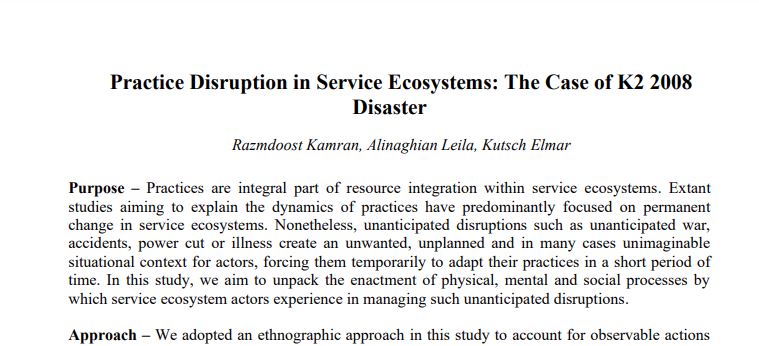
Conference paper image taken from https://naplesforumonservice.com/wp-content/uploads/2021/09/Razmdoost.pdf
So, if we were using this conference paper in an assignment or an article, its bibliographic reference would look like this:
Razmdoost, K., Alinaghian, L. & Kutsch, E. (2021, September 6-9). Practice disruption in service ecosystems: the case of K2 2008 disaster [Conference paper]. 7th Naples forum on service, Naples, Italy.
Remember that APA7 references should all be formatted with a hanging indent.
Your in-text citations (where you refer to the work within your own text) would simply include the authors’ surnames and the year of publication so they would be…
Razmdoost, Alinaghian & Kutsch (2021) or, where you were quoting directly, Razmdoost, Alinaghian & Kutsch (2021, p3).
Any questions about referencing? Consult our Referencing and Plagiarism pages or drop us an email here.
Please note: Cranfield supports two different referencing styles – APA7 (Author-date) and Numbered (NLM). Please make sure you use the style preferred by your supervisor or lecturer. The advice above relates only to the APA7 style. If you have any questions about referencing, please contact the Library.
Feature image from Pixabay. Available at: https://cdn.pixabay.com/photo/2016/06/01/06/26/open-book-1428428_960_720.jpg

Categories & Tags:
Leave a comment on this post:
You might also like…

Introducing Barrington Library
Welcome to all our new students! Barrington Library supports all the students and staff at Cranfield Defence and Security on the Shrivenham site. We are looking forward to meeting you all soon, in person or ...

About to start your journey at Cranfield? We’re here to help!
Congratulations on accepting your offer to study at Cranfield! If you’re keen to get a head start before your course begins, our Library Services team is here to support you every step of the way. ...
Bank holiday hours for Library Services: Monday 31 August
Library Services staff will be taking a break on Monday 31 August for the bank holiday. You will still be able to access all the resources and help you need via our library website. The 24/7 ...

The real cost of studying in the UK – what international students need to budget for
Moving overseas to pursue a postgraduate degree is one of the most exciting investments you can make in your future. It's also one of the most significant financial commitments you and your family will ...
Seven things you should definitely prepare for before studying at Cranfield University
You're thinking about Cranfield. Maybe you've done the virtual tour, read through the course pages, spoken to the course director or attended a webinar. Now, you're trying to figure out what life here is ...

From insurance to aerospace: why I chose to study a PhD with Cranfield
My path to studying for a PhD wasn't exactly a straight line. I had just graduated with an MEng in Aerospace Engineering from the University of Surrey and, like a lot of people, wasn't ...