

The secrets of great paper aeroplanes
14/06/2022
Paper aeroplanes are a fantastic source of inspiration for aeronautical engineering studies. Like most people, I have this memory of making paper aeroplanes with friends when we were kids. It was enjoyable to watch the finished products and have small competitions. I started to take paper aeroplanes seriously during my undergraduate studies. We had paper aeroplane competitions in the aeronautical department, and I realised that I was way more enthusiastic about making paper aeroplanes and could do better than anybody else! I found peace, joy and a sense of achievement out of paper aeroplanes.
Since then, I have been winning paper aeroplane competitions. In 2015, I was awarded champion of the longest paper aeroplane competition with 38.10m in China. This year, I created a UK national record (48.21m) and won second place (57.07m) in an international paper aeroplane competition.
I am delighted to be involved in the preparation and judging of the Cranfield Great Paper Aeroplane Competition for our aerospace MSc students. The Cranfield paper aeroplane competition is organised and has been sponsored by the Cranfield College of Aeronautics Alumni Association for many years. The competition has four cash prize-winning categories:
- the greatest linear distance
- the longest airtime
- the most stable flight with stored power
- the greatest technical merit of design
The aeroplane must be constructed from paper and glue only (except for the stored energy flight). There are no limitations on physical dimensions. A panel of judges will assess the flight and merit of the designs. I have won twice in the greatest linear distance category.
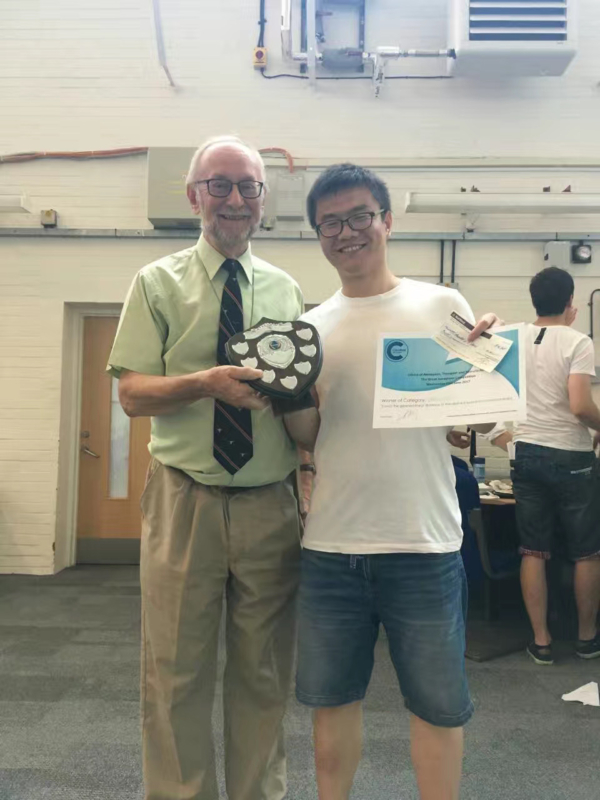
Winning the Cranfield Great Paper Aeroplane Competition
As I reflect on my ‘secrets’ of great paper aeroplanes, I realise that there are three main aspects for paper aeroplane makers: design, build and fly.
1. Design
The designs of the paper aeroplanes have been optimised by trial-and-error through a large number of design cycles. Similar to the biological evolutionary process, the most popular designs have shown to be the most performing. Therefore, I would suggest not starting from scratch, but starting with some well-performed designs. Standing on the shoulder of giants, you are more likely to stand out, if you can make some difference.
Like many kinds of real aircraft, there are many kinds of paper aeroplane designs. Some designs target longer distances, which are usually featured with a dart-like configuration to reduce drag. Some designs target longer airtimes, which are usually featured with larger wing areas to maintain a high lift-to-drag ratio. Some designs can fly acrobatically, which can fly a loop by shifting the centre of gravity positions backwards or have flapping wings utilising the aeroelastic effect.
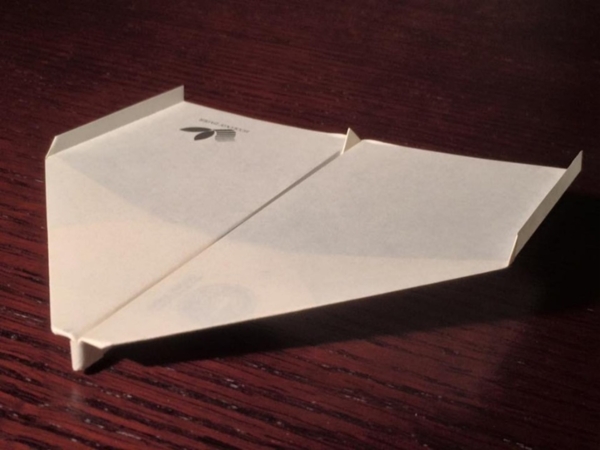
A world record paper aeroplane design
2. Build
Every single folding accounts for a paper aeroplane. Unlike a real aeroplane, there is no complex inner structure under the paper aeroplane’s skin. We build a paper aeroplane by mainly folding the paper. However, the quality of the creases can affect the strength of a paper aeroplane and its aerodynamic performance. I usually use a credit card or a cobblestone to press the creases so that they are nice and solid.
Precision is important for both real aeroplanes and paper aeroplanes. If the wing of a paper aeroplane is not visually symmetrical, it is more likely to roll or spin. Sometimes, a ruler and a pencil are needed to help with the precision of the folding.
One more practical tip is to glue the wings together so that they will not open wide in the air. Otherwise, there will be a huge loss in the aerodynamic efficiency.
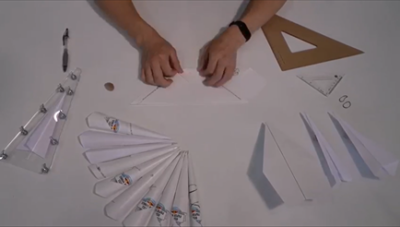
Making paper aeroplanes
3. Fly
The angle and speed you throw at the influence the paper aeroplane’s flight performance. Unlike a real aeroplane, a paper aeroplane has no power or control devices during its flight. Too small or too large of the throwing angle will result in a short flight distance. To fly for longer airtime, you had better throw your aeroplane as vertical/high as possible so that it can gain higher potential energy. To find out the correct throwing angle for your aeroplane, you need to keep practising.
The faster the aeroplane flies, the more likely it travels a long distance. For a dart-like design, the wing area is small, therefore, the stall speed is high. A larger airspeed can help the aeroplane to stay aloft. If you want to throw it faster, a pre-run can help to increase the speed and some muscle buildings are definitely helpful. However, for some larger wing designs, the rigidity of the aeroplane is low. A very high throwing speed can cause a deflection of the paper and result in a flight failure.
I really hope this information will enable you to go and practice with your own paper aeroplane designs.
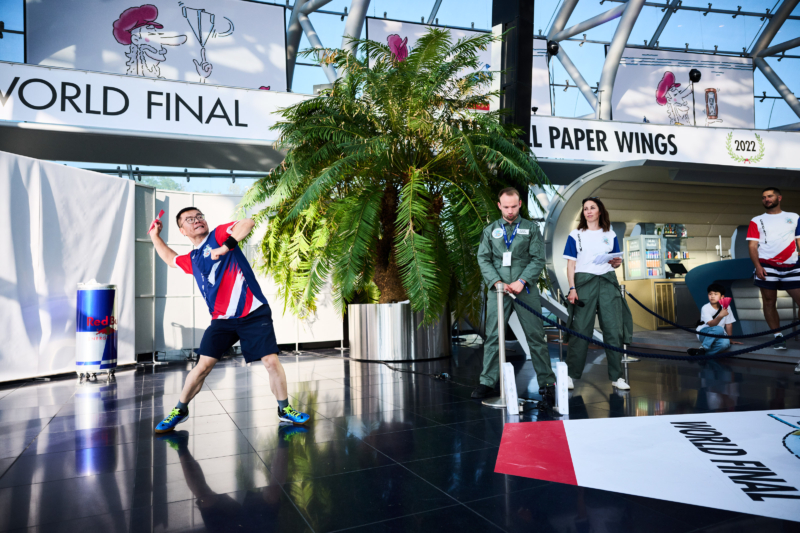
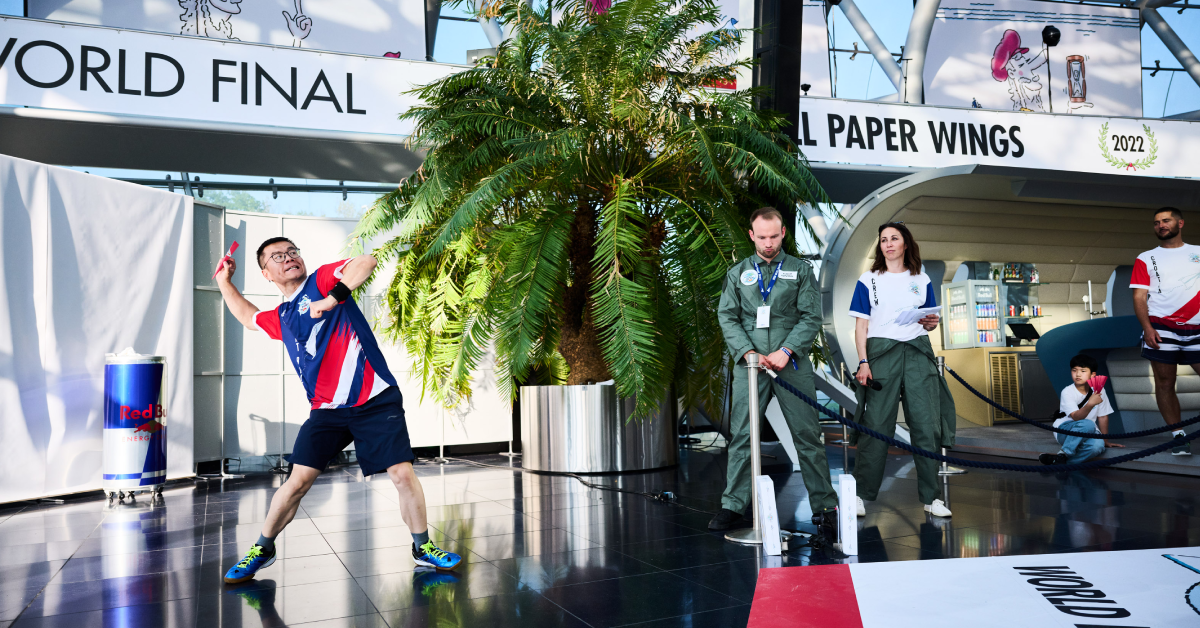
Yicheng Sun of Great Britain performs in the Longest Distance discipline during the Red Bull Paper Wings World Finals 2022 in Salzburg, Austria on May 14, 2022.
Cranfield University provides a wide portfolio of aerospace MSc courses that cover aspects of aircraft design, aerodynamics and flight dynamics.
Want to get involved in this year’s Great Paper Aeroplane Competition? Four cash prizes to be won!
Sponsored by the Cranfield College of Aeronautics Alumni Association (CCAAA)
Our Paper Aeroplane Competition is open to all staff and students at Cranfield University.
Winners will be in four categories and prizes will be awarded for the aircraft that:
- Travels the greatest linear distance (no stored energy) – (prize £20)
- Remains aloft for the longest time (no stored energy) – (prize £20)
- Make the most stable flight with stored energy* – (prize £30)
- With the greatest technical merit** – (prize £50)
* Any kind of onboard stored energy is acceptable.
**The aircraft will have to fly well and a one page design review will be required.
The Rules
- The paper aeroplane must be constructed from paper and glue only. Stored energy systems for flight are permitted for category 3, in addition to paper and glue.
- There are no limitations on physical dimensions.
- The paper aeroplane must be hand-launched into free flight.
- Each entrant is allowed with one design for up to two trials.
- Entrants may be individuals, groups, or both. Each entrant should register with yicheng.sun@cranfield.ac.uk, stating team name, member name(s), and department.
- A referee will be appointed who will be responsible for judging the distance travelled by aeroplane, the time aloft and for interpreting the competition rules. A panel of judges will assess the flight and merit and their decision is final.

Categories & Tags:
Leave a comment on this post:
You might also like…

Formula 1 was the dream and Cranfield was the conduit
I still remember the exact moment Formula 1 (F1) got its hooks into me. I was in my first year of an aerospace undergraduate engineering degree when I watched a video about the sport ...

Introducing Barrington Library
Welcome to all our new students! Barrington Library supports all the students and staff at Cranfield Defence and Security on the Shrivenham site. We are looking forward to meeting you all soon, in person or ...

About to start your journey at Cranfield? We’re here to help!
Congratulations on accepting your offer to study at Cranfield! If you’re keen to get a head start before your course begins, our Library Services team is here to support you every step of the way. ...

Bank holiday hours for Library Services: Monday 31 August
Library Services staff will be taking a break on Monday 31 August for the bank holiday. You will still be able to access all the resources and help you need via our library website. The 24/7 ...
The real cost of studying in the UK – what international students need to budget for
Moving overseas to pursue a postgraduate degree is one of the most exciting investments you can make in your future. It's also one of the most significant financial commitments you and your family will ...
Seven things you should definitely prepare for before studying at Cranfield University
You're thinking about Cranfield. Maybe you've done the virtual tour, read through the course pages, spoken to the course director or attended a webinar. Now, you're trying to figure out what life here is ...
Comments are closed.