


What makes the Accident Investigation course at Cranfield worth attending?
19/11/2021
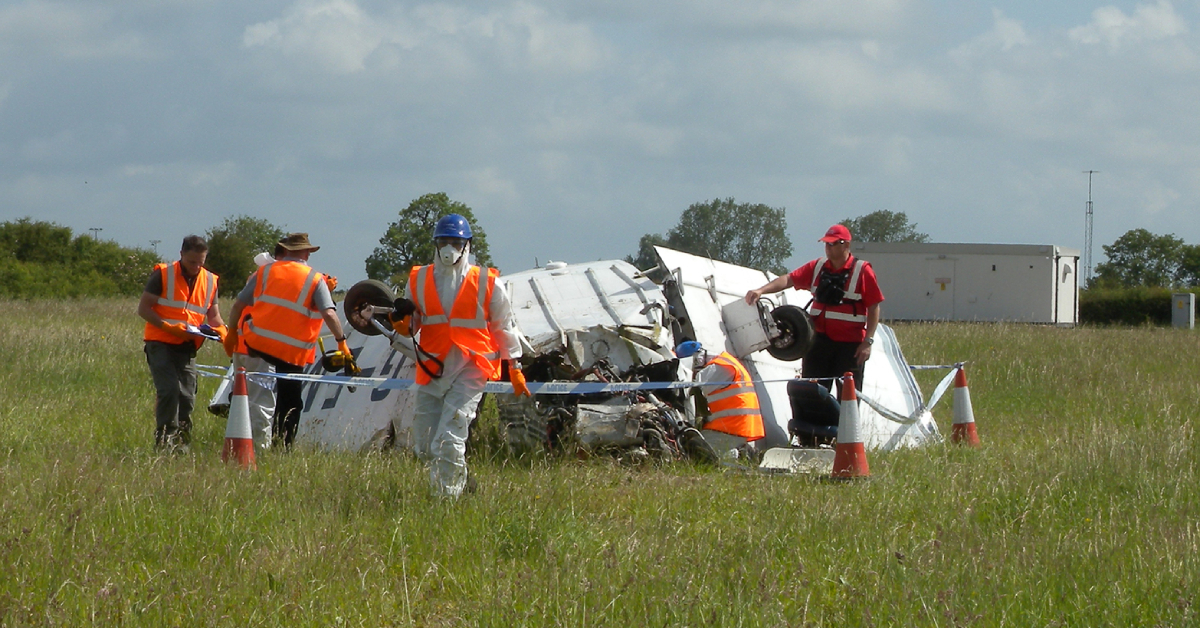
Recently, we have delivered another successful Accident Investigation course at Cranfield University. The Cranfield Safety and Accident Investigation Centre (CSAIC) succeeded in further developing trained investigators to contribute to making the world safer. The course was organised without too many restrictions on account of COVID-19, which had affected the teaching, learning methods and student experience since the start of the pandemic.
CSAIC has been a centre of excellence in the accident investigation field for over 40 years. The first accident investigation course was conducted in cooperation with the UK Air Accidents Investigation Branch in 1977. The award of the Queen’s Anniversary Prize in 2011, which is the highest award a UK academic institution can receive, was bestowed for the high-quality research and training in accident investigation that CSAIC provides.
I recently delivered the last lecture in the course under the title: What happens next – an investigator’s perspective. In this session, I shared my perspective as an investigator who previously attended the Accident Investigation course at Cranfield and then had the opportunity to investigate some real accidents. The majority of delegates had not had any opportunity to attend real accident investigations, but they would do so after finishing their training at Cranfield.
In this blog, I aim to answer the question: what makes the Accident Investigation course at Cranfield worth attending? The last course attracted a diverse cohort of students; there were individuals from different continents such as Europe, Australia and North America. The gathering of participants from countries worldwide was found to be greatly beneficial for exchanging their perspectives and experiences based on their different cultures. During the course period, participants are assigned differently to work with each other and share their knowledge and critical thinking through different activities.
It was a matter of argument for a long time between experts in the field as to the correct way of teaching a topic such as accident investigation. One of those is Dr Eddie Trimble, the former leader of Cranfield accident investigation field exercises. He believed that accident investigation needs to be taught in a practical, hands-on-way. Looking at the reality behind investigating an accident or serious incident and how these activities are conducted, it could be challenging to attempt to teach this topic in the classroom without supporting the lectures with practical sessions. These sessions are comprised of different workshops and simulations, which are carefully selected and placed within each course to ensure participants gain the maximum benefit. This allows them to practice their knowledge in a safe environment known as the Accident Investigation Lab, which is a unique research and teaching facility providing realistic hands-on training to trainee investigators.
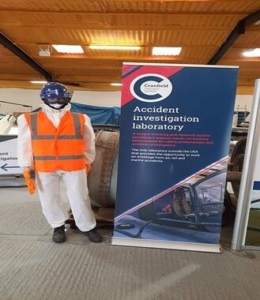
Accident Investigation Laboratory
Having the opportunity to engage with different subject matter experts during the different activities of the courses, it is not difficult to notice how participants’ fears and hesitations totally disappear just before the end of the course as they become more knowledgeable and confident in the topic. Things such as identity re-shaping and energising friendships – old and new – are among the course benefits. During the course activities, participants will usually broaden their perspectives and use the different activities to develop knowledge and skills and increase awareness of global challenges and industry requirements.
The course structure and design is another story. It was aimed for a student to accept the responsibility to be self-disciplined, which requires seeing things as they are, embracing reality, and acting based on that awareness. In addition, the course was structured to be relaxed over six weeks, as it comprised three weeks followed by another three weeks, which can be attended continuously or in two parts. The first three weeks – Fundamentals of Accident Investigation (FoAI) – are usually attended by participants from different disciplines – air, rail, marine, health and industry. While the published aim of the course is to provide accident investigators with the fundamental knowledge and skills to conduct a general transport accident investigation, from my perspective, the most important outcome is that investigators will learn how to assess the existing hazards and the exposure risks to ensure their safety in accident sites. The principles of collecting and preserving evidence are almost the same among different disciplines, so students will share their knowledge and experience while benefiting from interacting with each other. Having successfully passed the FoAI course, participants will move to attend a further applied accident investigation course, specifically in their field of work. Currently, there are three applied courses related to the three transport modes – air, rail and marine.
Considering participants’ needs and their right to have a recognised academic level in accident investigation, the accident investigation courses can be counted as a requirement for different academic levels – Postgraduate Certificate, Postgraduate Diploma or MSc in Safety and Accident Investigation as shown in tables 1, 2 and 3.
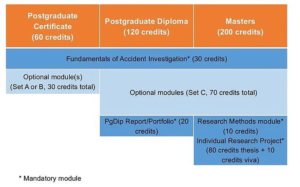
Table (1) – The requirements of different academic levels
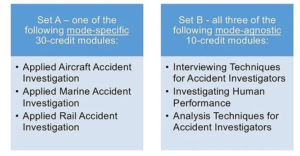
Table (2) – The two sets A and B optional modules for the postgraduate level
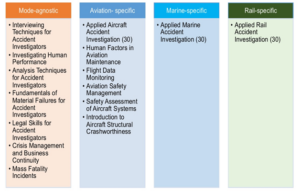
Table (3) – The set C optional modules for the Postgraduate Diploma and the MSc levels
Interested in learning more? Our Cranfield Safety and Accident Investigation Centre (CSAIC) offers many accident investigation-focused CPD courses. Get in touch for further information.
Want to download our brochure? Brochure | Safety and Accident Investigation (cranfield.ac.uk)

Categories & Tags:
Leave a comment on this post:
You might also like…

5 budgeting mistakes students make (and how to avoid them)
Good financial planning isn't about how much money you have. It's about the habits you build. We asked Dr Lakshmy Subramanian, Course Director for the Banking, Economics and Finance MSc, about the budgeting mistakes ...
Finding your reading materials
Use Library Search Library Search is the first place to start when you are trying to find academic sources for your work. This is the search box on the library website homepage. It allows you ...

Formula 1 was the dream and Cranfield was the conduit
I still remember the exact moment Formula 1 (F1) got its hooks into me. I was in my first year of an aerospace undergraduate engineering degree when I watched a video about the sport ...
Introducing Barrington Library
Welcome to all our new students! Barrington Library supports all the students and staff at Cranfield Defence and Security on the Shrivenham site. We are looking forward to meeting you all soon, in person or ...

About to start your journey at Cranfield? We’re here to help!
Congratulations on accepting your offer to study at Cranfield! If you’re keen to get a head start before your course begins, our Library Services team is here to support you every step of the way. ...

Bank holiday hours for Library Services: Monday 31 August
Library Services staff will be taking a break on Monday 31 August for the bank holiday. You will still be able to access all the resources and help you need via our library website. The 24/7 ...
Comments are closed.