


National Flying Laboratory Centre student experience flight: A must for aeronautics students.
14/09/2020
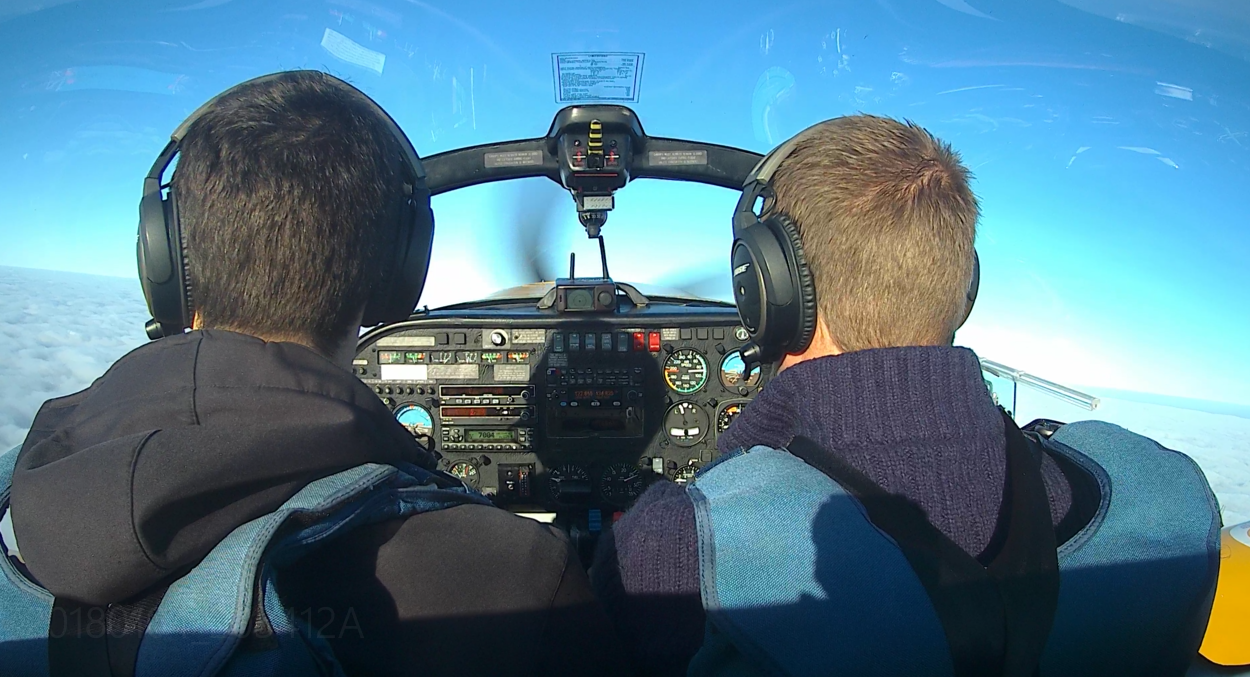
Students on selected Cranfield aerospace MSc courses are able to participate in this practical experience of flight to complement their MSc studies.
Built upon the theories of aerodynamics, the effects of controls and the effect of gravity on the human body, the experience introduces you to the concepts of spatial disorientation, human factors in complex systems and how aircraft, airfields and airspace are organised to enhance the safe operation of aircraft.
At the end of the flight, you will have gained a practical understanding of the theory of powered flight and an appreciation of the controls of an aircraft.
Dominic Schmid, Aerospace Dynamics MSc student, provides us with a personal insight into his experience.
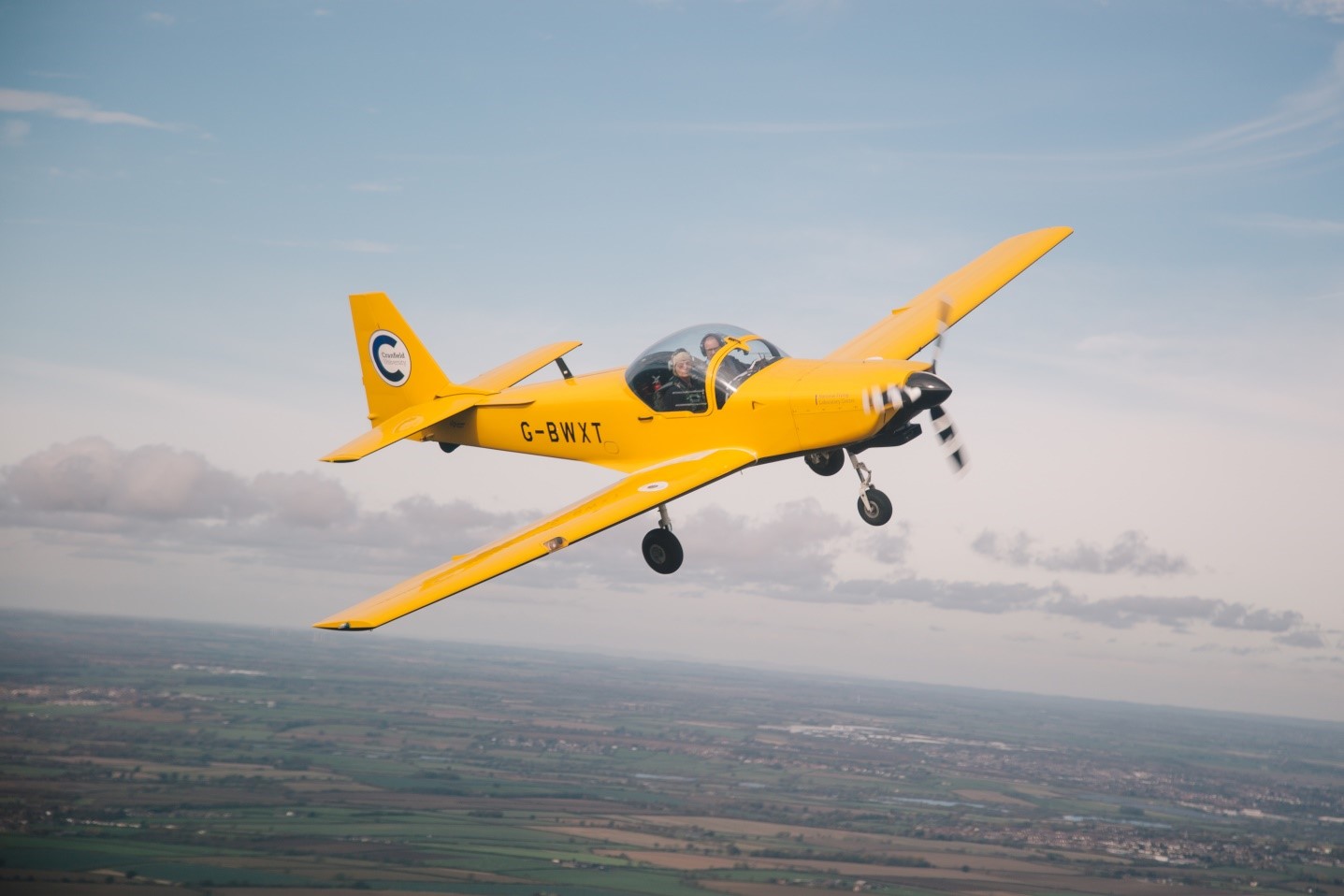
^ Image: Cranfield University’s Slingsby T67
“As we lined up on the Cranfield Airport runway and I gently moved the throttle to the front panel I knew I was in serious emotional trouble! For me this student experience flight was an experience to remember and confirmation for my understanding of the theory from my Aerospace Dynamics MSc studies.
It was a cold but sunny January morning when I met Senior Pilot Rob Harrison in the briefing room to prepare. After the safety instructions and pre-flight check we took the Slingsby T67, a former Royal Air Force trainer, to Run-up 21. The reason I felt emotional, even before take-off, was the roaring and the feel of pure power from a massive 6-cylinder Lycoming engine.
As an already licensed aerobatic private pilot, I know that only excess power can make flying an even better experience – a fact which would be confirmed during the next 40 minutes. As we lined up, released the brakes and opened the throttle, the Slingsby started to accelerate madly. We climbed at what felt to be a steep climb altitude but when I watched the Go-Pro footage back shortly after take-off we were still over the runway – but 3000 feet above it! Rob then illustrated to me the control and stability characteristics of the Slingsby which confirmed my understanding from my studies.
I experienced several enlightened moments and the flight definitely helped me understand some of the topics better. Rob gave me the controls of the aircraft and I could do whatever I wanted. I took the Slingsby to a series of epic loops and barrel rolls and had as much fun as one can possibly have. After a 40 minute flight we had to return to Cranfield Airport. For me the NFLC student experience flight was great fun with a big learning outcome. “
Find more details about Aerospace Dynamics MSc at: www.cranfield.ac.uk/Courses/Taught/Aerospace-Dynamics

Categories & Tags:
Leave a comment on this post:
You might also like…

About to start your journey at Cranfield? We’re here to help!
Congratulations on accepting your offer to study at Cranfield! If you’re keen to get a head start before your course begins, our Library Services team is here to support you every step of the way. ...

Bank holiday hours for Library Services: Monday 31 August
Library Services staff will be taking a break on Monday 31 August for the bank holiday. You will still be able to access all the resources and help you need via our library website. The 24/7 ...

The real cost of studying in the UK – what international students need to budget for
Moving overseas to pursue a postgraduate degree is one of the most exciting investments you can make in your future. It's also one of the most significant financial commitments you and your family will ...
Seven things you should definitely prepare for before studying at Cranfield University
You're thinking about Cranfield. Maybe you've done the virtual tour, read through the course pages, spoken to the course director or attended a webinar. Now, you're trying to figure out what life here is ...
From insurance to aerospace: why I chose to study a PhD with Cranfield
My path to studying for a PhD wasn't exactly a straight line. I had just graduated with an MEng in Aerospace Engineering from the University of Surrey and, like a lot of people, wasn't ...

How to build a business that keeps growing
Ask any business owner about their ambitions and "growth" will almost certainly feature near the top of the list. More customers, higher revenues, larger teams and new markets are often seen as signs of ...