


Office-Mania!!
25/06/2020

I was just 6 months into my PhD when this pandemic started. I had just gotten used to being in a new environment, got a new house and suddenly something changed. I found myself having to adapt to a new situation, and I kept repeating myself “you have to stay at home and manage your time better now”.
When I had to cope with this new situation, I started to narrow down what was keeping me up in the office. I tried to recreate my entire day at university, at home. I know it sounds crazy, but it is actually not!
First thing first: what did I have on my desk? What did I actually need? So, I wrote a list of things that I was using daily when I was at my desk. I went through my Uni routine: from 8.30 until 5 I worked, then from 5.30 until 6.30 it’s gym time (I have to be honest, gym time was not an “everyday thing”), then I ate dinner, watched a film and went to sleep.
The thing that I liked more when I was at the university, at my desk, was setting it up and cleaning it afterwards. It seems weird, but that was the key thing that helped me through this entire pandemic.
So, literally every morning I am preparing my desk at home. I set up my computer, I insert two plugs (one for the phone) and I linked my wireless headphones. On the right side of my laptop, I place my notebook and my pencil case and, on the left, … my first espresso!
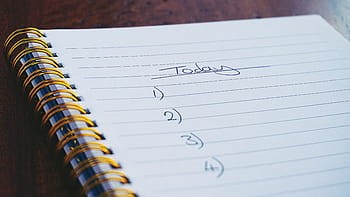
Then, I read my “Stop Worrying!” timetable. I think the main problem with the pandemic was feeling like you are not doing enough. That is why managing your time is the best thing that can help you to understand how much you are doing and If you are doing enough. My “Stop Worrying!” timetable is a list of things that I have to do, together with their deadlines. In this way, I knew what task I had to do for the day. You have no idea how satisfying it is crossing something off from that list once you have done it.
When you go into the office, you set your mind from 8 until 5, but when you are at home you do not look at the time anymore. The problem that I had at the beginning of this time was to try and manage not only my time, but also my entire project. Usually, the first part is about writing literature review, and even though I did my literature review I did not focus about writing much compared to fieldwork. So, when the lockdown came, I had to deal with the fact the I had a lot of writing to do and had to plan for it.
Every evening around 5 I place everything back leaving my desk completely empty. In this way I manage to have my office hours at home. I started to feel like we are always worrying too much, but that every time something comes that can interfere with the PhD is actually something that we can turn around.

Categories & Tags:
Leave a comment on this post:
You might also like…

5 budgeting mistakes students make (and how to avoid them)
Good financial planning isn't about how much money you have. It's about the habits you build. We asked Dr Lakshmy Subramanian, Course Director for the Banking, Economics and Finance MSc, about the budgeting mistakes ...
Finding your reading materials
Use Library Search Library Search is the first place to start when you are trying to find academic sources for your work. This is the search box on the library website homepage. It allows you ...

Formula 1 was the dream and Cranfield was the conduit
I still remember the exact moment Formula 1 (F1) got its hooks into me. I was in my first year of an aerospace undergraduate engineering degree when I watched a video about the sport ...
Introducing Barrington Library
Welcome to all our new students! Barrington Library supports all the students and staff at Cranfield Defence and Security on the Shrivenham site. We are looking forward to meeting you all soon, in person or ...

About to start your journey at Cranfield? We’re here to help!
Congratulations on accepting your offer to study at Cranfield! If you’re keen to get a head start before your course begins, our Library Services team is here to support you every step of the way. ...

Bank holiday hours for Library Services: Monday 31 August
Library Services staff will be taking a break on Monday 31 August for the bank holiday. You will still be able to access all the resources and help you need via our library website. The 24/7 ...