


Why Best Practice Fails – Cynefin Framework and Adopting Techniques That Work – second of four on this subject
01/03/2019
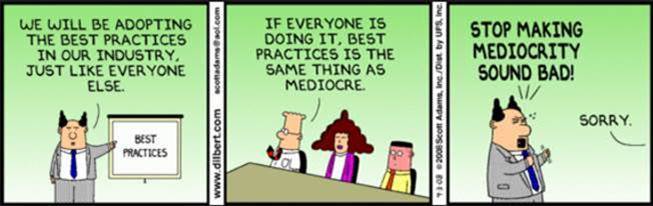
Some while ago, we blogged about how the use of Best Practice is the well-trodden path to mediocrity.
Not only does adoption of so-called Best Practice lead to mediocrity. Transferring Best Practice from one context, where the conditions were right for it to work, to another, where there are different conditions, can often lead to costly failure. In our previous blog, we introduced the Cynefin Framework, and this helps explain why.
In that last blog, we ran through the Simple Domain. Best Practice only works in this Simple Domain. Many real-life business situations are Complicated, Complex or even Chaotic. In this second of four blogs, we’ll run through the Complicated Domain.
In the previous blog we introduced the Simple Domain, and in this blog we’ll cover the Complicated Domain.
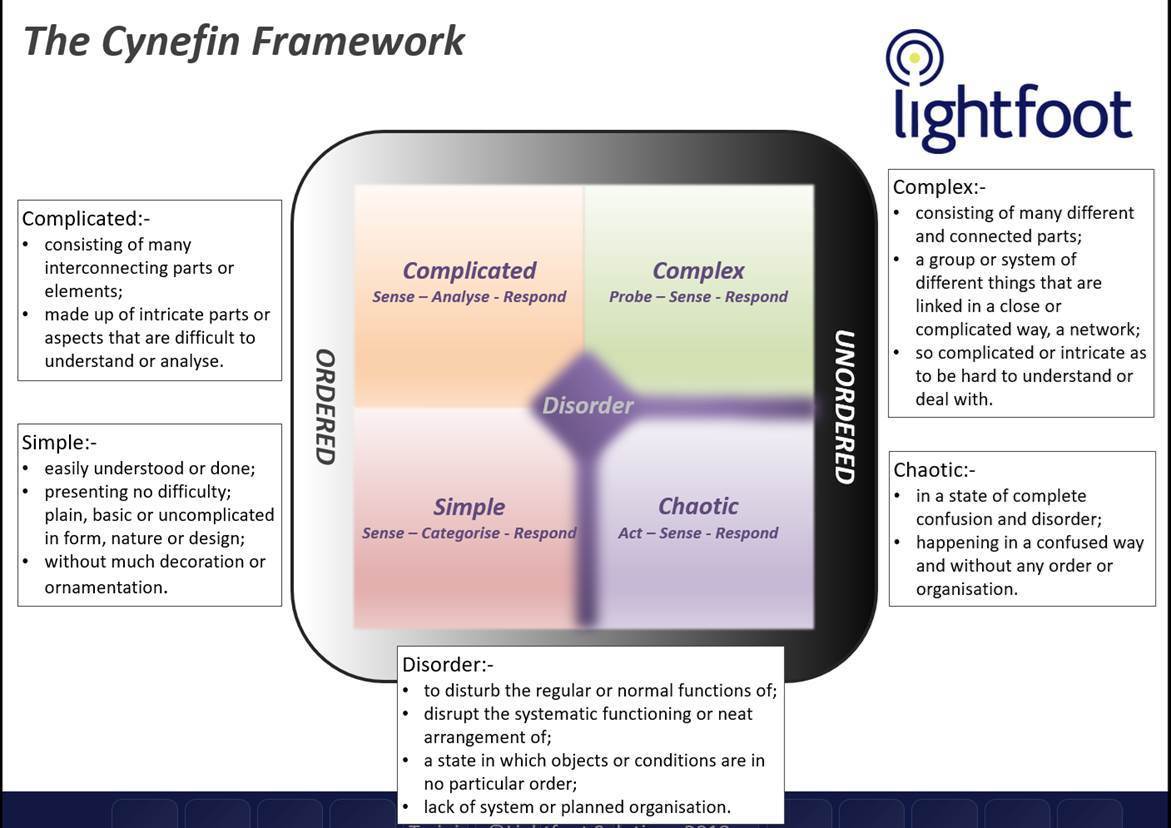
Complicated Domain (Volatility = Medium; Uncertainty = Medium; Complexity = Medium; Ambiguity = Medium): For example the whole end to end Lead to Cash (L2C) Business Process of ordering a new telephone line, broadband, TV and other services, through to it all being provided and working satisfactorily – that’s Complicated! The environment can be complicated particularly if the house is newly built, there are no cables to the house, meaning contractors need to dig, road traffic management arranged, ducting laid, cables laid and connected at either end, electronic devices set up correctly at both ends, and so on.
However, the Complicated Business System to provide the service is (usually) made up from a series of sequential Simple Business Processes or Stages. But these Processes/Stages can coalesce into functional “silos” – which can create dysfunctional behaviour. For example, openreach operates separately (under scrutiny from and enforced by the Regulator) from BT, which can create significant challenges.
There is usually a logical Flow through the System, but each silo becomes a domain for “experts”. Within the silos, these experts’ preferred approach is analysis (as opposed to synthesis – or analysis at the System-level) using all the BI and BA tools available. The System is taken apart, and the focus is on making the parts function better. So the tendency is for each silo to search for, or develop, its own set of the many techniques and tools that worked in the Simple Domain. So we end up with Process/Stage analysis and improvement, rather than synthesis and System improvement. Techniques that work well here include things such as Problem & Purpose Workshops, System/Process Discovery Workshops, Visual Control Systems (providing a so-called Gantry View – see previous blog on Data Visualisation, Fantastic Beasts and Where to Find Them), Logical Thinking Process and Boyd’s OODA Loop. Best Practice does not.
And again, the Complicated Environment might change – perhaps there is unseasonal weather that causes problems with the underground works and joints, or the Regulator suddenly demands that a certain higher Broadband speed is achieved, meaning significant changes to the electronic devices at either end. These kinds of changes could push the Complicated System into Disorder for a while. But again, it will normally recover after a few days or weeks.
…. Next time, we’ll take a look at the Complex Domain
…. Or, in the meantime, you could take the Dilbert approach and end up failing, or mediocre at best!

Categories & Tags:
Leave a comment on this post:
You might also like…

5 budgeting mistakes students make (and how to avoid them)
Good financial planning isn't about how much money you have. It's about the habits you build. We asked Dr Lakshmy Subramanian, Course Director for the Banking, Economics and Finance MSc, about the budgeting mistakes ...

Finding your reading materials
Use Library Search Library Search is the first place to start when you are trying to find academic sources for your work. This is the search box on the library website homepage. It allows you ...

Formula 1 was the dream and Cranfield was the conduit
I still remember the exact moment Formula 1 (F1) got its hooks into me. I was in my first year of an aerospace undergraduate engineering degree when I watched a video about the sport ...

Introducing Barrington Library
Welcome to all our new students! Barrington Library supports all the students and staff at Cranfield Defence and Security on the Shrivenham site. We are looking forward to meeting you all soon, in person or ...

About to start your journey at Cranfield? We’re here to help!
Congratulations on accepting your offer to study at Cranfield! If you’re keen to get a head start before your course begins, our Library Services team is here to support you every step of the way. ...

Bank holiday hours for Library Services: Monday 31 August
Library Services staff will be taking a break on Monday 31 August for the bank holiday. You will still be able to access all the resources and help you need via our library website. The 24/7 ...