

Introducing… Citation analysis
23/08/2017

It’s common practice when you’re doing research to take a good paper and follow up on its references, looking for anything you haven’t yet read, to make your research more comprehensive. This involves working backwards in time, sourcing the works the original author used.
An excellent way to find relevant – and more recent – papers is to take the same key paper and work forwards in time – to do what is called ‘citation analysis’. Citation analysis is the process of analysing the impact of an article or an author by counting the number of times it / they have been cited in other works. In other words, looking at how this work has shaped future research.
There are a selection of resources which allow you to do this kind of analysis, including Web of Science, Scopus and Google Scholar. Each one works in a similar way, but because they all cover different bodies of literature, results will vary. In brief, Web of Science and Scopus only count citations within articles listed within their own databanks. For this reason, Google Scholar, which also includes books, grey literature and conference papers, will give you much higher results, due to this wider range of materials.
To demonstrate how this works, we shall take the following paper by strategy guru Henry Mintzberg:
Web of Science
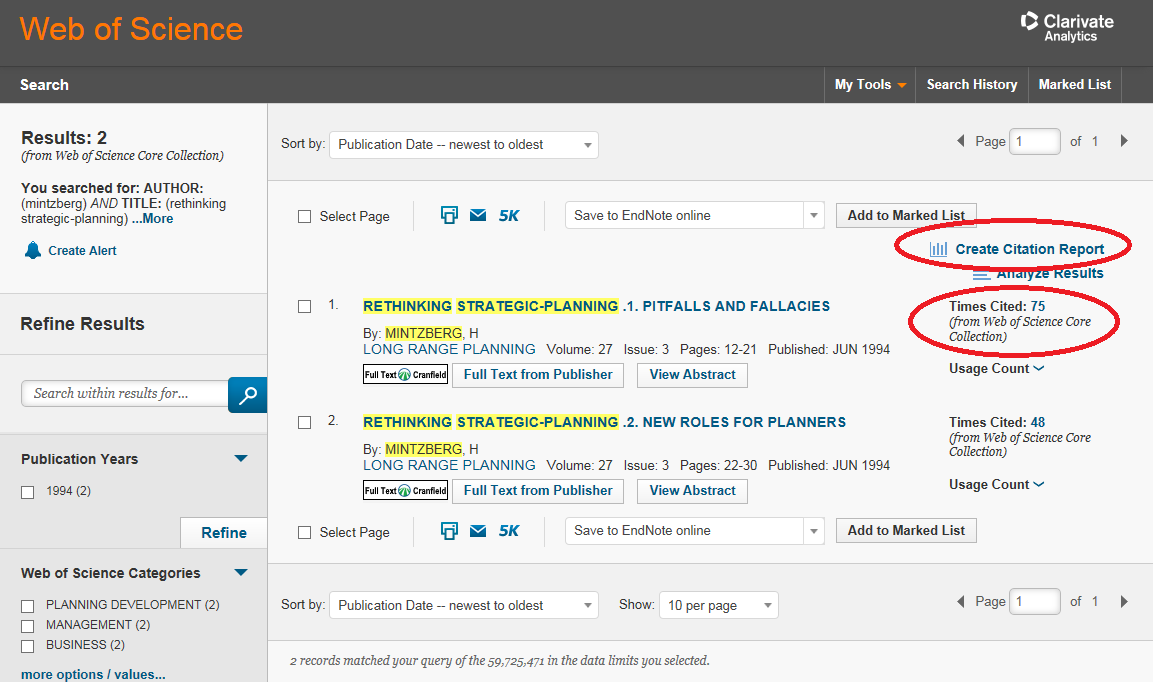
Using Web of Science you can input the details of the article and find out how many times it has been cited. Web of Science offers two options for analysis:
- ‘Times Cited’ will take us through to the list of citing papers.
- ‘Create Citation Report’, the top option, will show citation history and further analysis.
Citing articles can easily be reviewed.
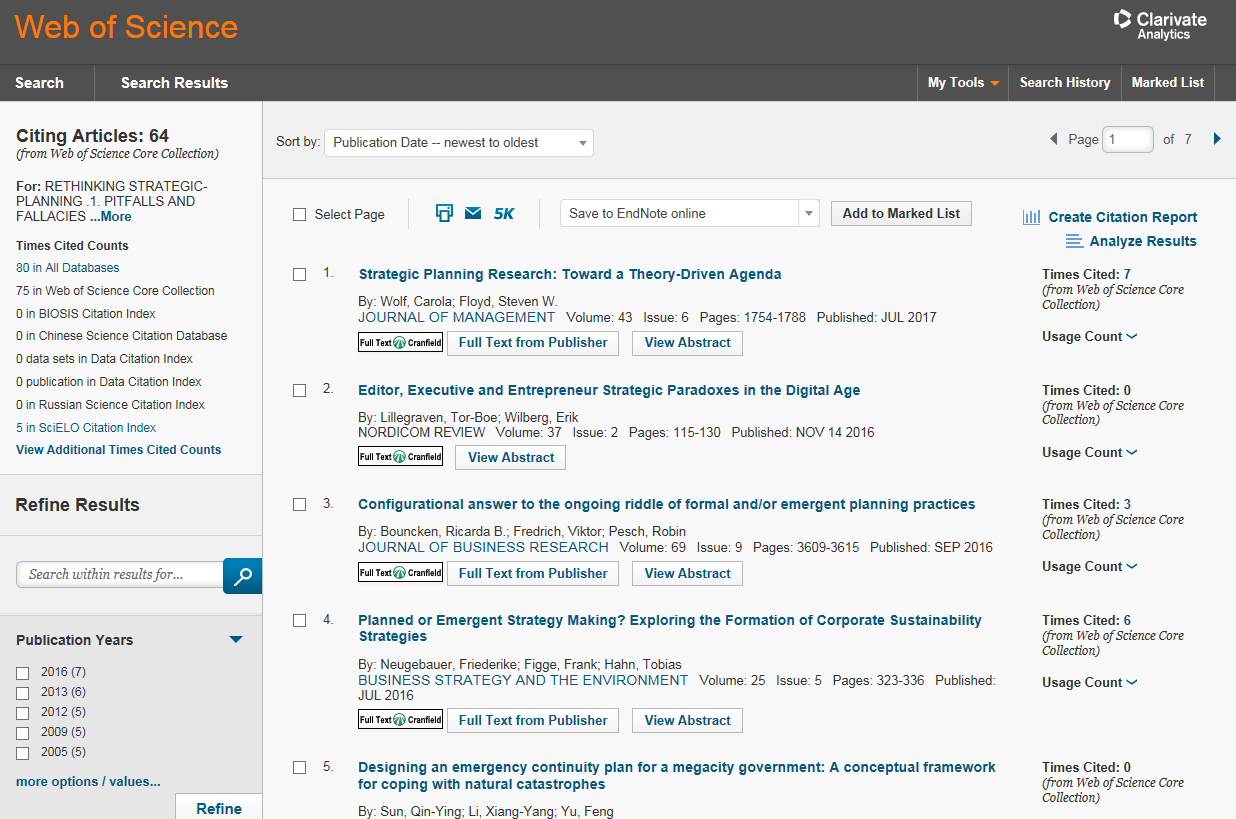
The same analysis can be done on an author or a topic. This could be employed to check how well-cited an author is or how long a specific subject term has been in use.
Scopus
Scopus works in a similar way and can also be used to search for both individual papers and topics. Within Scopus, there are again two choices available for analysis:
- ‘View citation overview’ – which gives an overview of the citation history.
- ‘View Cited by’ – which provides a list of all the articles citing the original item.
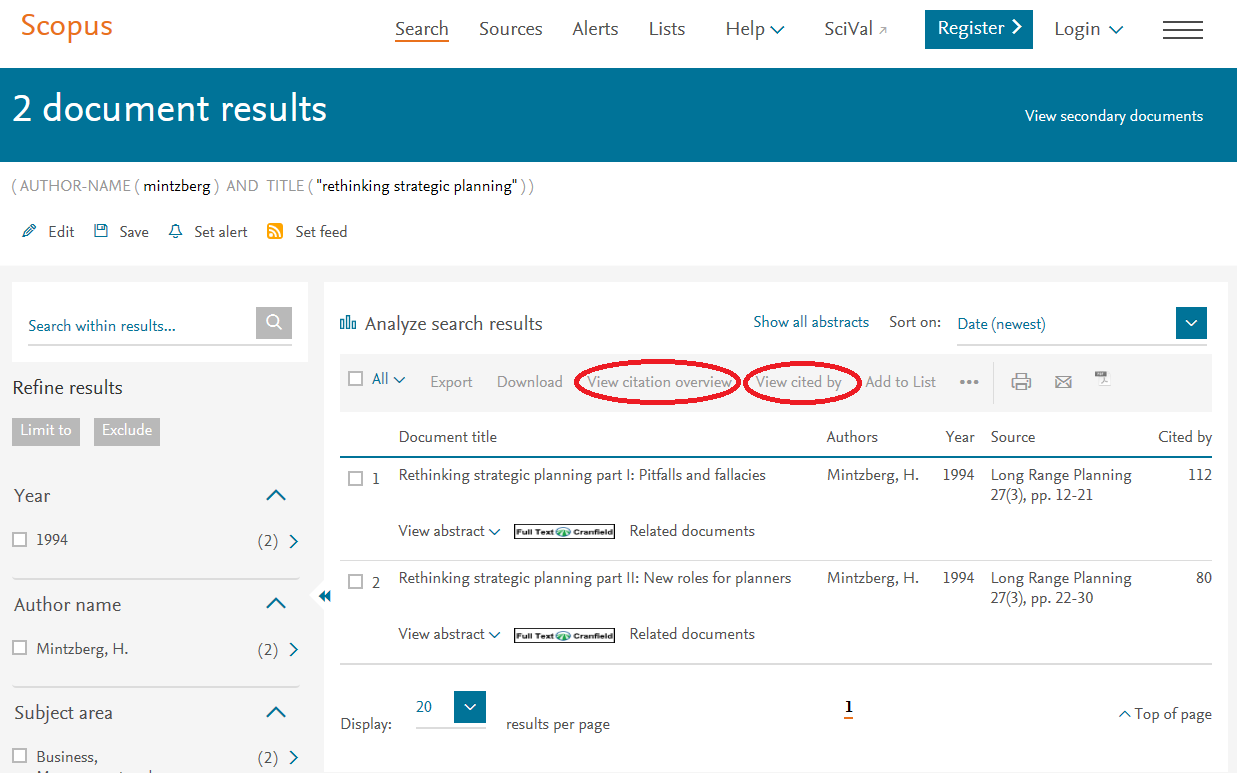
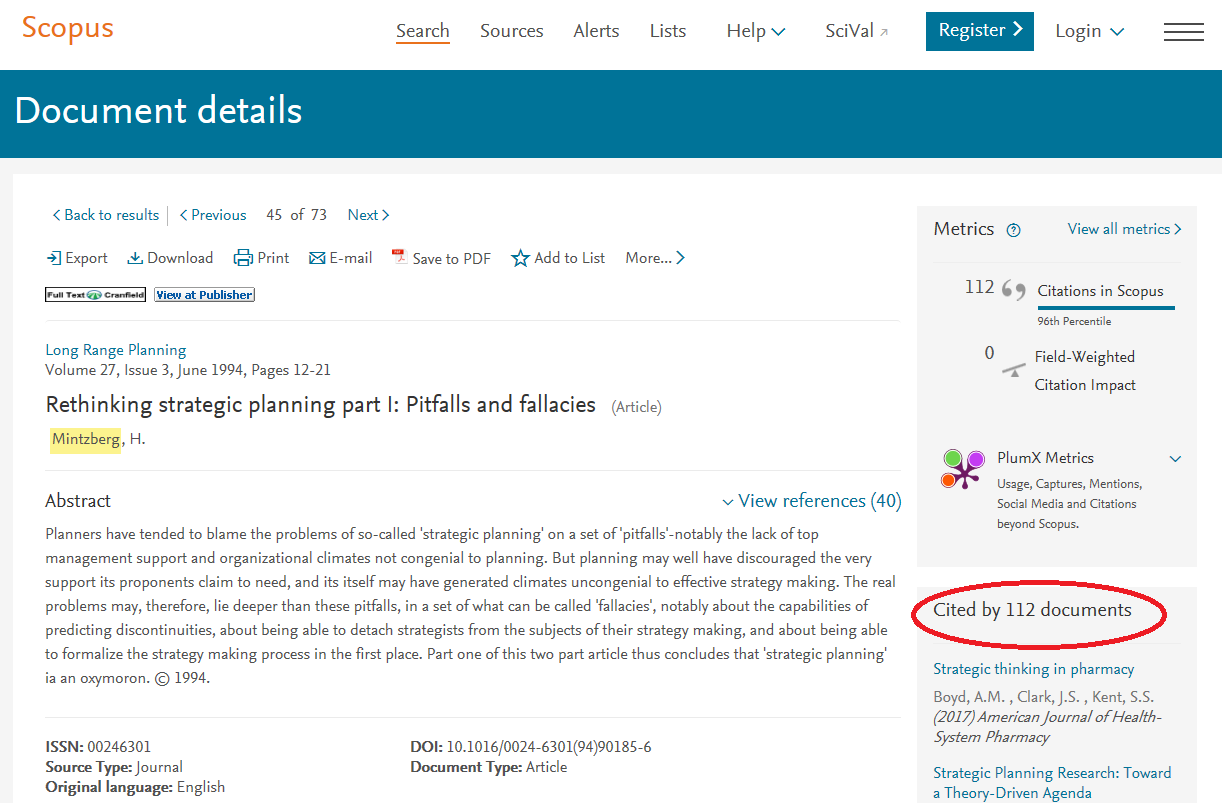
Within the document record, you can view citing documents at the bottom right of the document screen.
Google Scholar
Like Web of Science and Scopus, Google Scholar also tracks citations. When you search for an article, citations are displayed in your results as shown here.
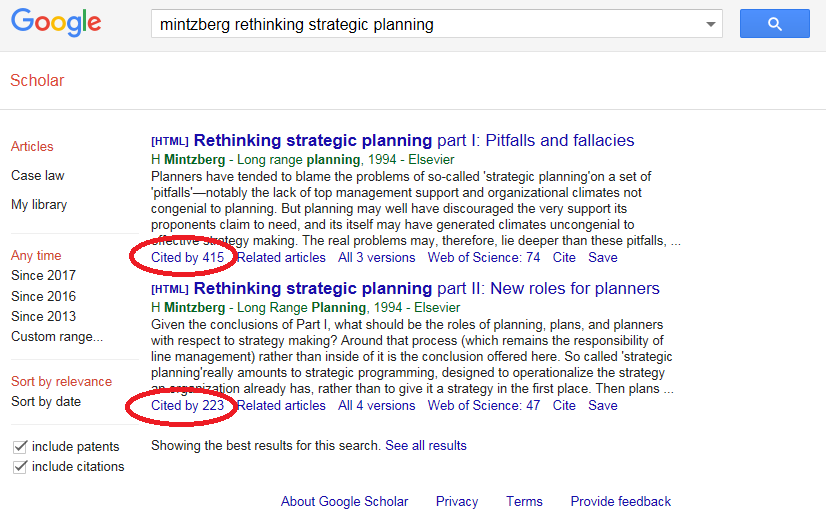
You can click through to view the citations but, unlike Web of Science and Scopus however, no further analysis is available.
As mentioned before, Google Scholar searches will generally give you much higher citation counts than services such as Scopus and Web of Science. This is because Google counts citations in books, conference papers etc. in its analysis.
If you have any questions about citation analysis or any other aspect of your research, please do not hesitate to contact the Library.
Feature image from Pixabay. Available at: https://cdn.pixabay.com/photo/2016/06/01/06/26/open-book-1428428_960_720.jpg

Categories & Tags:
Leave a comment on this post:
You might also like…

From passion to purpose: My journey at the Pinnacle of Aviation
By: Sultana Yassin Abdi MSc Air Transport Management, Current Student Born and raised in the vibrant landscape of the UAE, with roots stretching back to Somalia, my life has always been ...
From Sri Lanka to Cranfield: How a Commonwealth Scholarship transformed my environmental engineering journey
Hi, I’m Kavithanjali Uthayashangar and I’m here to tell you about my journey into environmental engineering. It began with a simple but powerful motivation: a desire to understand how engineering can ...
Celebrating excellence: Cranfield’s first Student Funding Team Celebration Event
On Wednesday 21 January, the Cranfield Student Association (CSA) played host to a significant occasion: our first-ever Student Funding scholarship celebration. Hosted by Diane Blything (Assistant Registrar) and Gill Ireland (Student ...

Aligning my passion and my career at Cranfield University
I’ve learnt to be flexible and try new things – you never know where it could take you to! Hello! My name is Sophie and I’m studying MSc Air Transport Management. Why did ...
From Sri Lanka to Cranfield: How a Commonwealth Scholarship transformed my environmental engineering journey
Hi, I’m Kavithanjali Uthayashangar and I’m here to tell you about my journey into environmental engineering. It began with a simple but powerful motivation: a desire to understand how engineering can ...

Inside the Air Transport Management MSc: Classes, assignments, and group project work
What’s it really like to study Air Transport Management at Cranfield? Adit walks us through a typical day, assignment expectations, and the excitement of hands-on group projects. This is the second of three blog ...