

Driving the future of automotive excellence with three new scholarships
08/06/2026
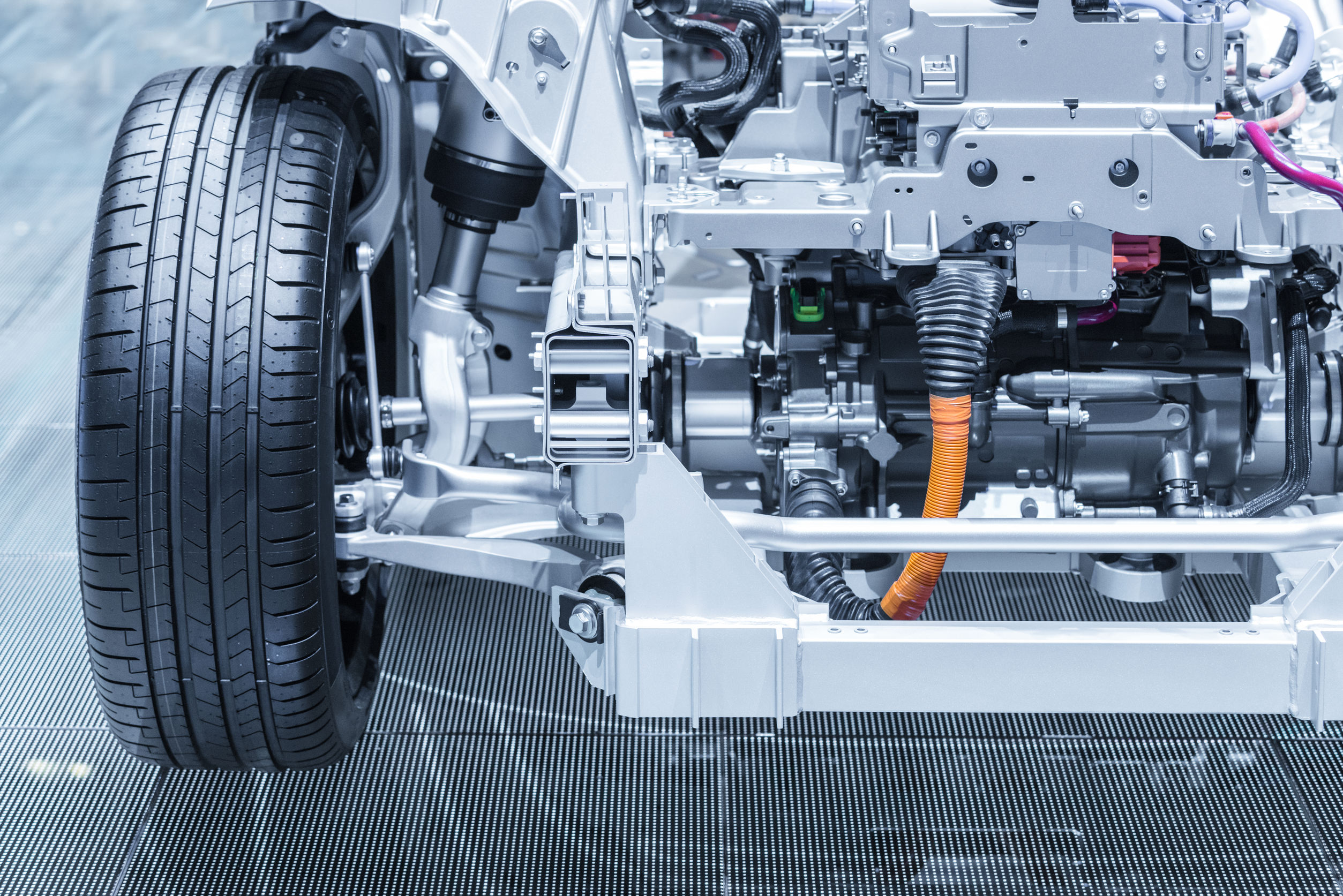
Cranfield University has a long history within the top echelon of motorsport, car development and safety designs within the automotive industry, working in the era where we’ve seen significant safety improvements, engineering feats and aerodynamic wonders built.
Our distinguished legacy of industry partnerships puts us at the forefront of motorsport, vehicle development, and automotive safety innovation. Over the years, our expertise has contributed to remarkable advances in engineering, aerodynamics, and safety technologies that have helped shape the modern automotive industry.
As an institution we sit side by side with world class motorsport and engineering, working with teams such as Caterham F1 in 2010 whose roots reach back to Lotus using our testing facilities to prepare cars in development. We’ve developed brilliance through our teaching, including current Team Principle, James Vowles, of the Atlassian Williams F1 Team, a Cranfield alumnus who graduated with an MSc in Motorsport Engineering and Management in 2001.
The work of the Cranfield Impact Centre is hugely complementary in this space. A state-of-the-art testing facility, featuring a range of test rigs for both static and dynamic testing of structures, it is one of just two FIA-approved test centres in the world, used for crash-testing Formula One cars. Tests can be carried out for certification or research purposes and, as a Fédération Internationale de l’Automobile (FIA) approved testing centre, it is used often by the FIA to officially confirm and verify parts such as safety cells, nose cones, front wing components or the ‘halo’ head protection – a process known in the industry as ‘homologation’.
Shaping safety in Formula One
The Halo is a titanium safety device designed for use in Formula 1 to protect drivers’ heads from debris and impacts. Its 2018 introduction revolutionised safety. Tested extensively at Cranfield Impact Centre during its development by the FIA (Federation Internationale de l’Automobile) prior to its adoption, the issue of head protection in motorsport has continued to be regularly investigated through MSc projects.
Mandatory in F1, the halo was hailed as a significant contributory factor in saving the life of F1 driver Romain Grosjean when he emerged from a fireball crash following a high-speed impact with a barrier at the Bahrain Grand Prix in 2020.
The Halo device proved to be the most important safety innovation since the HANS (Head and Neck Support) device and enhanced helmet technology were introduced in 2003.
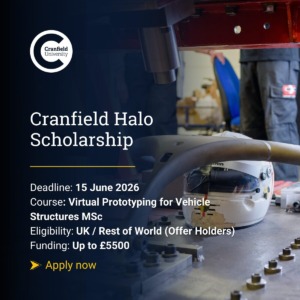
Safety innovation continues and it’s our driver for the Cranfield HALO Scholarship. Designed for those who hold an offer to study on the Virtual Prototyping for Vehicle Structures MSc. The funding, of up to £5500 of the course fee, is to invest in the next generation of engineers, innovators, and safety pioneers. It is designed for those who are driven not only to push boundaries, but to make them safer for everyone.
The scholarship is more than financial assistance. You will be given an internship to the prestigious Cranfield Impact Centre (CIC) and the chance to work with the team as they conduct their test and evaluation projects, University research projects and external supplier requirements, creating an unmatched opportunity to network with those involved at the CIC both commercially and academically.
Celebrating an icon by inspiring the next generation of innovators
One of motorsport’s greatest innovators was Colin Chapman. Recognised as one of the pioneers in automotive engineering, Chapman fundamentally changed how car designers saw aerodynamics and stability controls. His work in developing ‘ground-effect’ aerodynamics and active suspension were truly revolutionary.
Cranfield alumni had the opportunity to partner with Chapman to develop the ground-breaking Lotus 92. A car that would go on to be driven by Nigel Mansell in 1983, only a year after Chapman’s death.
The Lotus 92 was the first Formula 1 car to use ‘active-suspension’. This onboard control system automatically adjusted the vertical movement of each wheel to keep the largest amount of surface area on the track surface, maximising the available grip levels. A revolutionary technology in Formula 1 that was designed with the help of Cranfield alumni Professor David Williams.
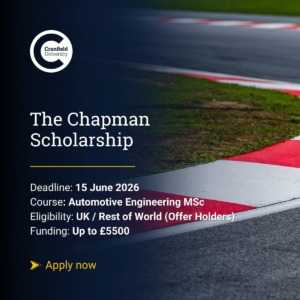
This year, as our homage to the great man, the Cranfield Colin Chapman Scholarship will be awarded to an offer holder of the Automotive Engineering MSc, with a value of up to £5500 towards the course fees. The scholarship was created with a core mission to help the next generation of automotive engineers and designers and invest in their development.
Pioneers of the past who are still shaping our future
Cranfield has a deep understanding of what the automotive industry needs and where the future of consumer and professional automotive industry. This includes our status as a leading research and development centre for hydrogen power and our Advanced Vehicle Engineering Centre which is working across multiple sectors including automotive, aerospace, agriculture, defence and motorsport, to leverage our specialisms in electric and hybrid vehicle batteries, autonomous vehicles, vehicle dynamics, brake system performance, hybrid material development for vehicle light-weighting, motorsport vehicle simulation and testing, mechatronic system development and tyre dynamics.
Our Automotive specialism focuses on the need to develop, apply and evaluate advanced technologies to help make ground vehicles more capable, sustainable and efficient, lighter, faster and more enjoyable to engage with, be that as a driver, passenger or operator.
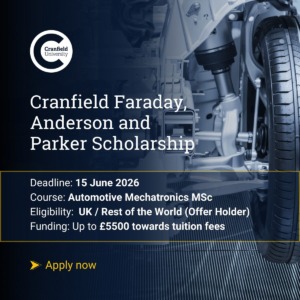
The Cranfield Faraday, Anderson and Parker Scholarship celebrates pioneering innovation in electrification and high-performance automotive engineering. Named after Michael Faraday, Robert Anderson, and Thomas Parker, the scholarship supports outstanding Automotive Mechatronics MSc applicants who demonstrate strong technical potential and a commitment to advancing sustainable, intelligent, and high-performance vehicle technologies.
These three great minds shaped how we used electrical power and how it could facilitate the enhancement in the automotive and locomotive industries that were finding their feet.
We are providing the scholarships with a value of up to £5500 towards tuition fees to applicants who can demonstrate a similar mindset and work ethic to that of these pioneering innovators and have ambitions of being part of the evolving world in power, engineering and automation.

Categories & Tags:
Leave a comment on this post:
You might also like…

Setting your research on the right course: Four questions every researcher should ask
Whether you are just beginning your doctoral journey or are already well into your research career, successful research rarely happens by accident. Like any successful mission, it depends on good planning, informed decisions, and getting ...

5 budgeting mistakes students make (and how to avoid them)
Good financial planning isn't about how much money you have. It's about the habits you build. We asked Dr Lakshmy Subramanian, Course Director for the Banking, Economics and Finance MSc, about the budgeting mistakes ...

Finding your reading materials
Use Library Search Library Search is the first place to start when you are trying to find academic sources for your work. This is the search box on the library website homepage. It allows you ...

Formula 1 was the dream and Cranfield was the conduit
I still remember the exact moment Formula 1 (F1) got its hooks into me. I was in my first year of an aerospace undergraduate engineering degree when I watched a video about the sport ...

Introducing Barrington Library
Welcome to all our new students! Barrington Library supports all the students and staff at Cranfield Defence and Security on the Shrivenham site. We are looking forward to meeting you all soon, in person or ...

About to start your journey at Cranfield? We’re here to help!
Congratulations on accepting your offer to study at Cranfield! If you’re keen to get a head start before your course begins, our Library Services team is here to support you every step of the way. ...