

Incorporating in-text citations into your work (APA7)
29/05/2025

When referencing other people’s work, such as books, journals, or data, you must correctly cite and reference the material used. There are several ways to incorporate an in-text citation into your work, depending on the type of material and the style of writing.
This post focuses on the conventions of citations in APA7. For information on NLM referencing, please see our introductory post at this link: https://blogs.cranfield.ac.uk/library/introducing-nlm/
APA7 citations use the AUTHOR-DATE format, usually in brackets at the end of a quotation or paragraph (Author, DATE). There are a number of ways in which these can be used in your work.
Firstly, think about the reason for your citation.
Source: Adapted from Hewings & Thaine, 2012, p59.
To explore that in more detail, here are some examples.
Directing the reader to more details could look like this:
Using a GANTT chart (APM, 2025), or similar planning tool, enables all members of a team to track the progress of a task or project.
Exemplifying studies or an approach:
Studies have shown that using GANNT charts can significantly improve project outcomes and delivery (Han, 2020; Briggs, 2023; Ford, 2024).
Acknowledging the source of an idea:
GANTT charts and other timekeeping tools are critical to project management (Jones, 2025) as well as being useful in everyday work and study.

Next, think about the where and how.
Citations can come mid-sentence, at the end of a sentence, at the end of a paragraph, or in the label of an image, dataset, chart or other media. It depends on the material and the flow of your work.
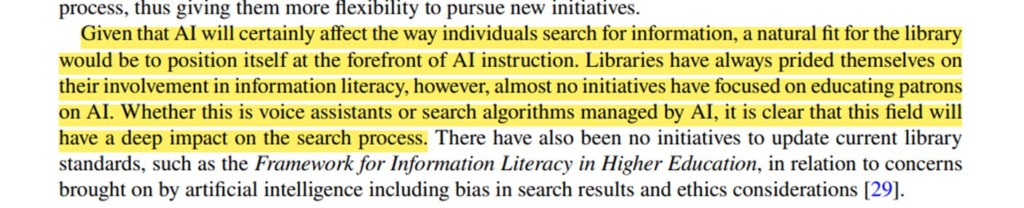
For example, imagine that the highlighted text in the image below is what you want to cite in your work.
Here are three possible ways that you could do that.
The first is a parenthetical citation. This is where the citation comes at the end of the statement or paragraph. In this example, I have paraphrased the content of the highlighted text.
Despite the impact of AI on conducting searches, academic libraries are behind the curve when it comes to offering training on its use (Wheatley & Hervieux, 2019).
The second is also a parenthetical citation, but this time using a direct quotation. Can you spot the difference in the citation to the example above?
A recent study on AI and academic libraries found that: “AI will certainly affect the way individuals search for information […] however, almost no initiatives have focused on educating patrons on AI.” (Wheatley & Hervieux, 2019, p. 353).
The direct quotation means a page number must be included in the citation to direct the reader to the source of the copied text.
The third option is a narrative citation. This is where the author’s name is introduced as part of the sentence, and only the date is given in brackets.
Wheatley and Hervieux (2019) found that very few libraries offer instruction on the use of AI.
It is good practice to include a range of direct quotation, paraphrase and citation styles into your work, again depending on the assignment type and writing style required.
For further support, visit the Cranfield Study Skills Hub resource on evidence and citations at this link: https://cranfield.instructure.com/courses/12169/pages/evidenced-3
You can also contact us for individual and small group support by emailing library@cranfield.ac.uk
Photo by Christina Morillo: https://www.pexels.com/photo/person-s-hands-on-top-of-macbook-air-1181307/
Featured image: Photo by Unseen Studio on Unsplash

Categories & Tags:
Leave a comment on this post:
You might also like…

Setting your research on the right course: Four questions every researcher should ask
Whether you are just beginning your doctoral journey or are already well into your research career, successful research rarely happens by accident. Like any successful mission, it depends on good planning, informed decisions, and getting ...

5 budgeting mistakes students make (and how to avoid them)
Good financial planning isn't about how much money you have. It's about the habits you build. We asked Dr Lakshmy Subramanian, Course Director for the Banking, Economics and Finance MSc, about the budgeting mistakes ...
Finding your reading materials
Use Library Search Library Search is the first place to start when you are trying to find academic sources for your work. This is the search box on the library website homepage. It allows you ...

Formula 1 was the dream and Cranfield was the conduit
I still remember the exact moment Formula 1 (F1) got its hooks into me. I was in my first year of an aerospace undergraduate engineering degree when I watched a video about the sport ...

Introducing Barrington Library
Welcome to all our new students! Barrington Library supports all the students and staff at Cranfield Defence and Security on the Shrivenham site. We are looking forward to meeting you all soon, in person or ...

About to start your journey at Cranfield? We’re here to help!
Congratulations on accepting your offer to study at Cranfield! If you’re keen to get a head start before your course begins, our Library Services team is here to support you every step of the way. ...
Comments are closed.