


Water footprint is the answer: what’s the question?
07/03/2016
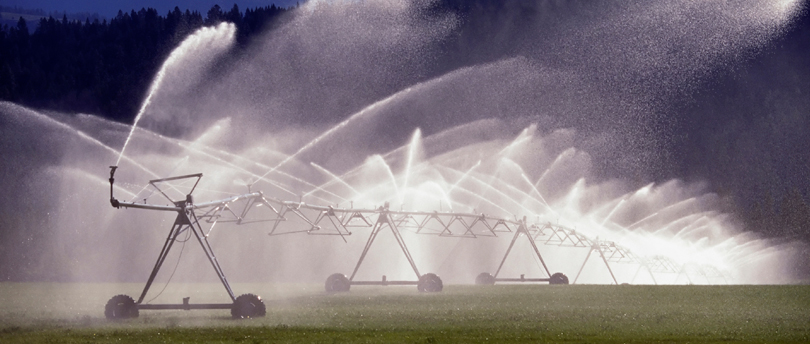
If you ask someone over dinner, “did you know that 7,000 litres of the world’s water have been consumed to bring the beef steak to your plate, but only 42 litres to provide the potatoes?” the answer is usually accompanied by shock (and disbelief). This provides a useful launch-point for a discussion about the sustainability of our lifestyles, but often ends up with the question “so, should we stop eating meat”?
Unfortunately the over-simplistic messages of water volumes have been widely abused to justify or encourage changes in diet and lifestyles. To answer the question about the impacts of our diet on the world’s water we need to unpack the numbers and think about potential impacts.
Firstly, how much of the total volume of water is “green” water (that is, rain water used by plants at the point where the rain falls)? Most British and Irish beef, for example, is largely fed on grass and grains that have been grown using rainfall only. We can argue that this water has a very low opportunity cost. If we stopped raising animals on that land, something else would be growing there (whether another crop, forest or natural vegetation) that would use at least as much water as the grass did and it would not make a substantial difference to the amount of water available in the basin for domestic, industrial and environmental uses. Secondly, what is the potential impact of using “blue” water (that is, water withdrawn from rivers, lakes and aquifers) on the availability of water for other users in the basin? 1 m3 withdrawn from a place (or time of year) with plentiful water resources has a much lower potential impact than 1 m3 withdrawn from a place where freshwater resources are scarce.
The modern western diet is rich in its diversity with foods coming from all round the world and grown in different agricultural systems; these will all have different potential impacts on the water footprint. Recently, we looked at the potential impact of the UK diet on water scarcity (Hess, et al. 2015. Food Policy, 50: 1-10) using the approaches of ISO14046. In total, we estimated that 56.2 Gm3 of water is consumed each year to support the diet of the UK. That is equivalent to 2,400 litres per person per day. However, most of this is from rain-fed agriculture, and the “blue” water consumed in supporting the UK diet is only 160 litres per person per day – which by coincidence is almost the same as the average daily per capita water use in our homes.
So what uses the largest amount of water? Read the full version of this blog post can be found on the Food Climate Research Network…

Categories & Tags:
Leave a comment on this post:
You might also like…

Introducing Kings Norton Library
Welcome to all our new students! We are looking forward to meeting you soon. You will find Kings Norton Library in the centre of the Cranfield campus, and it is open 24/7 to all staff ...

Setting your research on the right course: Four questions every researcher should ask
Whether you are just beginning your doctoral journey or are already well into your research career, successful research rarely happens by accident. Like any successful mission, it depends on good planning, informed decisions, and getting ...

5 budgeting mistakes students make (and how to avoid them)
Good financial planning isn't about how much money you have. It's about the habits you build. We asked Dr Lakshmy Subramanian, Course Director for the Banking, Economics and Finance MSc, about the budgeting mistakes ...

Finding your reading materials
Use Library Search Library Search is the first place to start when you are trying to find academic sources for your work. This is the search box on the library website homepage. It allows you ...

Formula 1 was the dream and Cranfield was the conduit
I still remember the exact moment Formula 1 (F1) got its hooks into me. I was in my first year of an aerospace undergraduate engineering degree when I watched a video about the sport ...

Introducing Barrington Library
Welcome to all our new students! Barrington Library supports all the students and staff at Cranfield Defence and Security on the Shrivenham site. We are looking forward to meeting you all soon, in person or ...