


What is the shelfmark and how do I use it to find a book in the library?
26/11/2019

We use a system called UDC to classify and store our books. Students are often confused by it when they try to find the items they need on our shelves. We are always happy to help you, but we have written this post for those of you who don’t like to ask us, or are looking for a book outside staff working hours.
The number, or shelfmark, on the spine of a book indicates a subject, so there could be a large number of books at any one shelfmark. Small numbers denote broad subjects, and longer numbers denote more specific ones. ‘Whole’ numbers, like the examples below, become more specific to a level of three numbers, before they are broken down by a decimal point to further subdivisions, for example:
6 = science and technology (broadest level)
65 = management science
656 = transport management
656.7 = air transport management
Some shelfmarks also incorporate punctuation, making them more difficult to find (sorry!). Punctuation indicates a relationship of one subject to another, but it also indicates where on the shelf you will find the book, in relation to the next whole number. All you need to understand is the order in which the most common punctuation marks are shelved, which is:
Slash (e.g. 66/77) – A book with this in the shelfmark would be shelved before books classified as the whole number of 66
Whole number (e.g. 66) – A book with the whole number would be shelved after books with a slash 66/67 – and before books classified with a colon
Colon (e.g. 656:3) – A book with a colon in the shelfmark would be shelved after books classified as the whole number 656 – and before books classified with brackets
Brackets (e.g. 656(4)) – A book with brackets in the shelfmark would be shelved after one with a colon 656:3, and before any with dashes
Dash (e.g. 656-52) – A book with a dash in the shelfmark would be shelved after books classified with brackets, 656(4), and before any classified with a decimal point
Decimal point (e.g. 656.7) – Decimal points indicate a sub-category of the previous whole number and would be shelved after any classified with a dash
What information do I need from the catalogue to find a book on the shelf?
The shelfmark is more than just a number, so you need to check Library Search (our catalogue) first before you start looking for a specific book. Once you are viewing the record for the item you want to find, look at the ‘Cranfield shelfmark’ field. Take a note of the full shelfmark, which includes the number plus the three letters (e.g. 656.7.08 KEY) that will appear on the spine of the book. All books classified at the same number are ordered on the shelf alphabetically according to those final three letters, so the combination should help you find the item you need quickly.
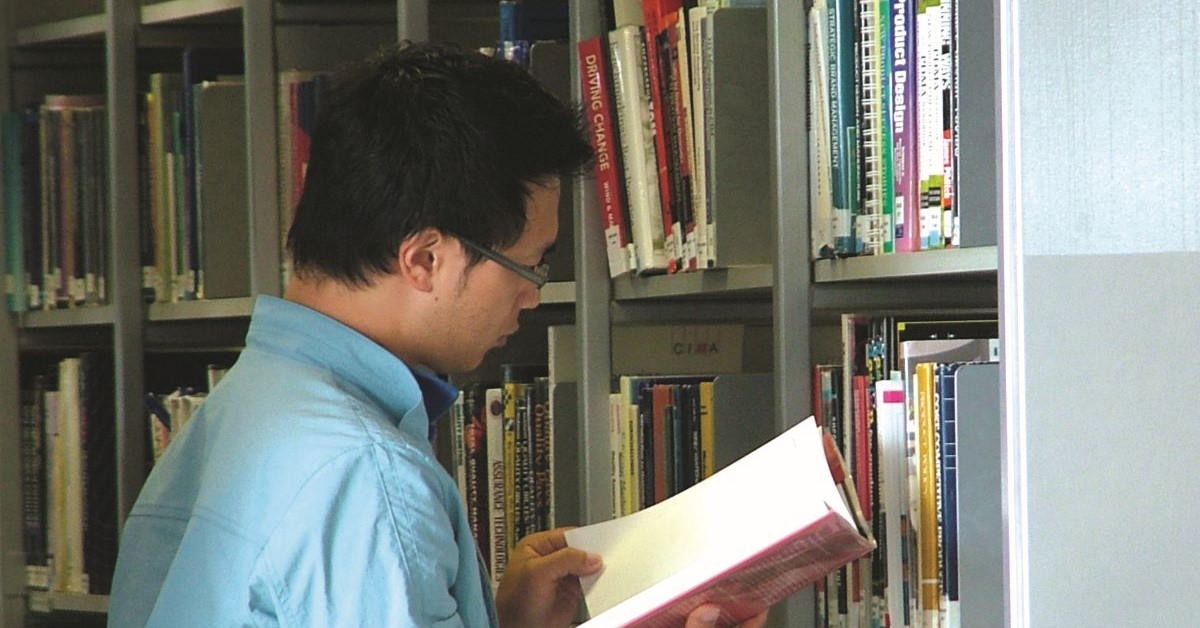
The signs at the end of each shelf give you an indication of which numbers are in which aisle.
But we know it’s complicated, so if you can’t find the book you’re looking for, please come and ask us for help!

Categories & Tags:
Leave a comment on this post:
Comments are closed.
You might also like…

5 budgeting mistakes students make (and how to avoid them)
Good financial planning isn't about how much money you have. It's about the habits you build. We asked Dr Lakshmy Subramanian, Course Director for the Banking, Economics and Finance MSc, about the budgeting mistakes ...
Finding your reading materials
Use Library Search Library Search is the first place to start when you are trying to find academic sources for your work. This is the search box on the library website homepage. It allows you ...

Formula 1 was the dream and Cranfield was the conduit
I still remember the exact moment Formula 1 (F1) got its hooks into me. I was in my first year of an aerospace undergraduate engineering degree when I watched a video about the sport ...

Introducing Barrington Library
Welcome to all our new students! Barrington Library supports all the students and staff at Cranfield Defence and Security on the Shrivenham site. We are looking forward to meeting you all soon, in person or ...

About to start your journey at Cranfield? We’re here to help!
Congratulations on accepting your offer to study at Cranfield! If you’re keen to get a head start before your course begins, our Library Services team is here to support you every step of the way. ...

Bank holiday hours for Library Services: Monday 31 August
Library Services staff will be taking a break on Monday 31 August for the bank holiday. You will still be able to access all the resources and help you need via our library website. The 24/7 ...
Thanks, I almost forget the classification although I was a shelver myself at Cranfield.
It’s a good reminder for me.