


Turn The Ship Around, Mission Command, and Jumping to Conclusions (Part three from four)
11/05/2018

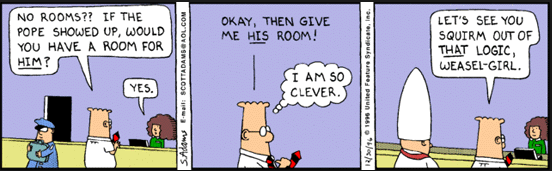
One of executive’s and management’s favourite sports is jumping to conclusions, or jumping to solutions before a problem is really understood and the evidence gathered!
It is one of the most difficult things, when facilitating a team to take up leadership or in solving problems, to not jump in with a solution! As Turn The Ship Around author, David Marquet, notes in one example where he and the Officer of the Deck (i.e. the guy who is responsible for the movement of the ship) are on the bridge and Marquet essentially asks the OOD to make a turn, rather than allowing him to explain why he was waiting a few seconds longer. This meant the OOD had immediately lost confidence and lost control and Marquet was immediately steering the ship! Not the right result!
We’ve been introducing the concept of Mission Command / Centralised Intent and its associated 8 Stages.
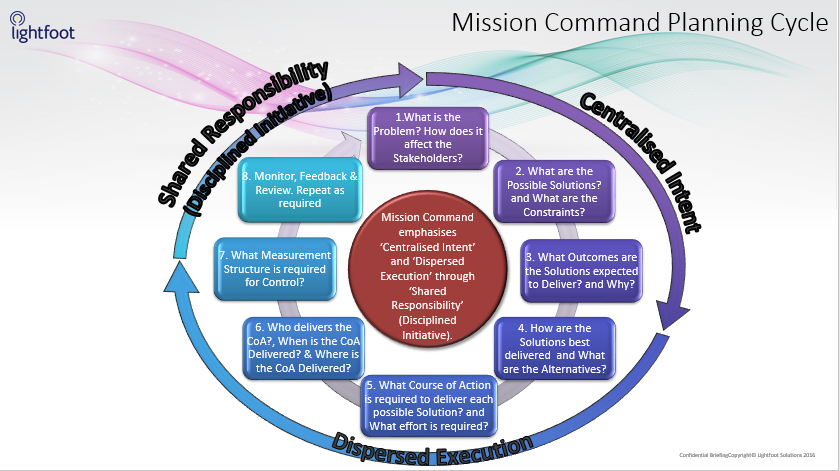
Last time, we covered Stage 1 under Centralised Intent. This time we’ll look at Stage 2.
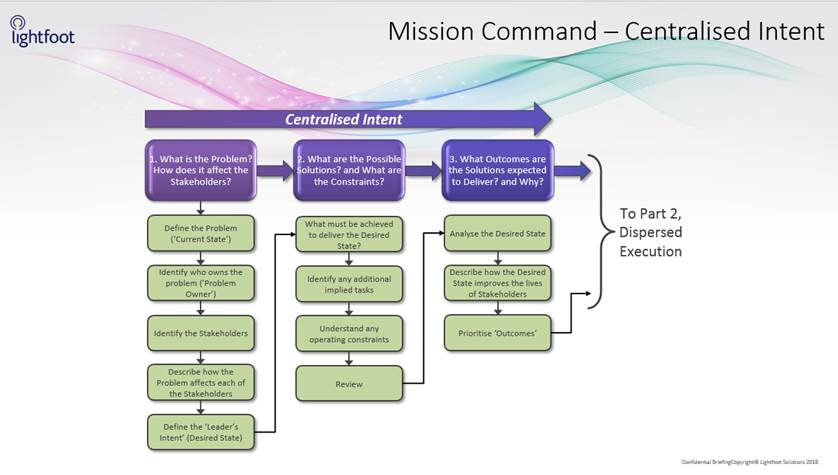
- What are the Possible Solutions? And What are the Constraints?
a. What must be achieved to deliver the Desired State: This is where it is essential to understand not only what your boss wants, but also his or her boss’ intent. It is essential because it not only enables you to reconcile it with the intent of your boss, but it enable you to grasp your role in the bigger picture. It also sets the context for what you are going to ask of your team.
For example, working with a Public Sector organisation: Executive and senior management were expressing the need for “One Team”. Yet, because some managers has not understood the Centralised Intent, they were holding onto critical staff for their portfolio even though they were at times essentially under-utilised, when there were other portfolio owners desperately short of resources. This level of understanding also provides guidance when unexpected events occur and overtake agreed plans – the antithesis of Micromanagement. Essentially, this is the basis of so-called “Agile”.
b. Identify any additional implied tasks: This is not about detailing “How” to deliver on Central intent. That is for the relevant teams closer to the front-line. This is about understanding the enablers that may need to be in place in order for the team to effectively perform their part in an organisation, in a programme, in a project or in an operational initiative.
For example, working with a Police Force: It was apparent that a Burglary initiative was required to reduce increasing crimes of this type. One of several enablers was the requirement to be able to visualise that data in a meaningful way – being able to see any strong seasonal patterns, whether the volumes were trending upwards or downwards etc. Without such visualisation, incorrect decisions get made and corrective action will have no impact except be a drain on costs. This meant another part of the organisation needed to provide information in this way, rather than providing binary comparisons (e.g. it’s up this month compared with the same month last year).
c. Understand any Operating Constraints: Usually, these manifest themselves in the form of time, resources and money, but could be Rules of Engagement.
For example, working with a global communications provider: Using the appropriate visualisation tools and techniques, network planners had identified a piece of equipment causing issues over a period of time. Budget was a constraint, but because they were able to identify the root cause of the problem as being this piece of equipment, able to calculate the costs of fixing faults on the network emanating from this equipment, a cost-analysis of £16,000 spent on an equipment rebuild vs £50,000 spent in less than a year of fault-fixing enabled a better result for the company and a better result for its customers. This method, propagated across the company led to £m’s in savings and also improved customer service.
d. Review: Take a step back at the start and periodically to assess whether the situation has changed. If it has, the Central Intent may no longer be valid.
For example: In 2014, there was a Central Intent when Teresa May was Home Secretary to appease the Public (mainly in London) by calling for Stop & search to be drastically reduced as a means of pro-actively preventing crime. Her intent was to prevent worsening relations with the public. This Central Intent is clearly no longer valid with the massive increase in knife- and gun-crime since then, to the extent Londoners are now calling for Stop & Search to be brought back, but possibly with different “Rules of Engagement”.
The Conclusion to this series on Mission Command will appear shortly following this blog.

Categories & Tags:
Leave a comment on this post:
Comments are closed.
You might also like…

Introducing Kings Norton Library
Welcome to all our new students! We are looking forward to meeting you soon. You will find Kings Norton Library in the centre of the Cranfield campus, and it is open 24/7 to all staff ...

Setting your research on the right course: Four questions every researcher should ask
Whether you are just beginning your doctoral journey or are already well into your research career, successful research rarely happens by accident. Like any successful mission, it depends on good planning, informed decisions, and getting ...

5 budgeting mistakes students make (and how to avoid them)
Good financial planning isn't about how much money you have. It's about the habits you build. We asked Dr Lakshmy Subramanian, Course Director for the Banking, Economics and Finance MSc, about the budgeting mistakes ...

Finding your reading materials
Use Library Search Library Search is the first place to start when you are trying to find academic sources for your work. This is the search box on the library website homepage. It allows you ...

Formula 1 was the dream and Cranfield was the conduit
I still remember the exact moment Formula 1 (F1) got its hooks into me. I was in my first year of an aerospace undergraduate engineering degree when I watched a video about the sport ...

Introducing Barrington Library
Welcome to all our new students! Barrington Library supports all the students and staff at Cranfield Defence and Security on the Shrivenham site. We are looking forward to meeting you all soon, in person or ...
Greetings Mr Anker
Thank you for your great articles based on D. Marquet’s book: Turn the Ship Around. I look forward to read your fourth and concluding part.
Suggestion: I would welcome a reflection on a situation where the ship’s captain does not realize that his/her ship should be turned around, even when its current location is clearly not the right one… More specifically, I am referring to project management or departmental guidance, for example, where the “old style” top-down captain (the PM) no longer has the esteem of his/her officers (the Team Leaders) because priorities keep changing without a shared logic and where listening is minimal, in particular to intentions to act in certain ways.
Thank you for considering this suggestion.
Cordially,
JF